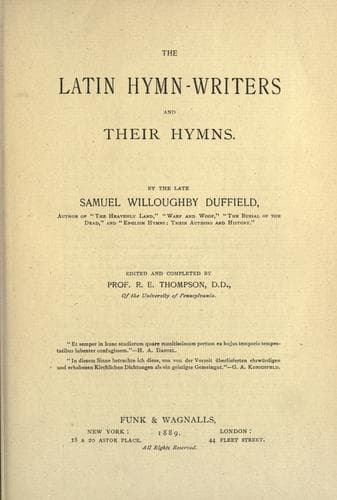
The Latin Hymn-writers and Their HymnsDuffield, Samuel Willoughby
Religion
The Latin Hymn-writers and Their Hymns
Duffield, Samuel Willoughby
Hymns, Latin -- History and criticism
He must have been born in 1092 or 1094—the earlier date being more
probable; and when he was sixteen or seventeen (1109) he became a monk
of Cluny. These were the “black” monks;—as the Cistercians of Citeaux
and Clairvaux were the “white.” He had six brothers, most of whom took
similar vows. What else indeed was there to do? You must either hack and
hew your way with a battle-axe, and risk your neck and your castle, or
you must become a monk. There was no middle course. Peace-loving,
studious people—those who aimed to help the world up toward God—had no
other choice. Nowadays we should find plenty of room for Peter; but he
did what was then best, and entered Cluny.
At thirty years of age he was its abbot. This was in 1122. It happened
by reason of Pontius, the former abbot, a self-sufficient and imperious
man, being forced to resign his office and go on pilgrimage to
Palestine; he even promised not to come back at all. Then the monks of
Cluny elected another abbot; and as he died almost immediately, they
were compelled to choose a third, namely Peter. But it was in a hard
seat that they placed him; he had a mismanaged property, and a body of
men who needed a good deal of attention.
Let us picture him to us in the fashion and habit of his appearance. He
had a “happy face,” a “majestic figure,” and “plenty of those other
unfailing signs of virtues” which justified his name “The Venerable.” It
was such a big-hearted, big-bodied style of man who now undertook this
reformation. By the help of Matthew, Prior of St. Martin in the Fields,
near Paris, he effected it in about three months. Then there was a
period of peace. But, all of a sudden, here comes Pontius, with soldiers
at his heels, when Peter is absent, wanting his old place again. He
bursts in the gates, forces the monks who remain to swear allegiance,
carries off crosses and candlesticks and whatever was worth anything for
melting down into money, and plays robber-baron over all the
neighborhood. Peter himself tells the story: “He came in my absence....
With a motley crowd of soldiers and women rushing in together, he
marched into the cloisters. He turned his hand to the sacred things....
He raided the villages and castles around the abbey, and, trying to
subdue the religious places in a barbaric way, he wasted with fire and
sword all that he could.” It was certainly a very serious matter.
Peter did the best he could with it—this resulting in Honorius II.
despatching a legate from Rome with a great curse, ready-baked and
smoking-hot, for the soul’s benefit of that “sacrilegious, schismatic,
and excommunicate usurper,” Pontius. I have not read the curse; but I am
positively certain that Pontius and Pontius Pilate must have been
elaborately compared in its sentences. Such anathemas were supposed to
dry the blood and wither the brain. Pontius trembled and restored his
ill gotten gains and vanished to his own place. And Peter had peace at
last.
Public-domain text, read in full here on John Shaqi.
Reviews
Reviews
No reviews yet
Be the first to share your thoughts on this work.
Elsewhere in the archive
Join the Discussion
Join the discussion
Sign in to leave a comment or review.
Sign InorCreate an account