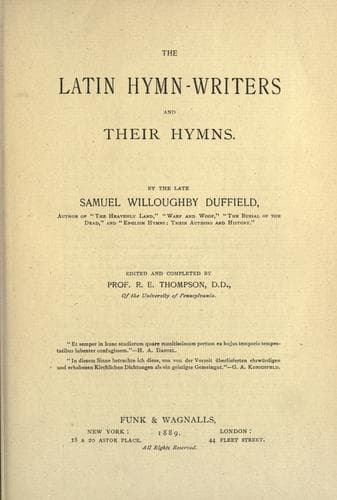
The Latin Hymn-writers and Their HymnsDuffield, Samuel Willoughby
Religion
The Latin Hymn-writers and Their Hymns
Duffield, Samuel Willoughby
Hymns, Latin -- History and criticism
The school of St. Victor, in Paris, was founded by William of Champeaux,
the teacher and rival of Abelard, at the commencement of the twelfth
century. It is known to history as having been the abode of three
distinguished scholars, Hugo, Richard, and Adam. Hugo and Richard of St.
Victor were mystics, and Vaughan, in _Hours with the Mystics_, has set
them before us. From this and other sources, we grow more and more
amazed to find the immense influence of such a school. A century from
its foundation showed St. Victor to be the parent of thirty abbeys and
of more than eighty priories. Here in these cells, like bees in a hive,
the busy monks were laying up the only honey of the Dark
Ages—multiplying manuscripts, delving into remote philosophies, muddling
their brains over abstruse questions, but now and then leaving behind
them something to benefit mankind. Theology and dialectics were their
great and indeed their only pursuits. Like the swirls of a sluggish
stream beneath its banks, they occasionally caught and kept fresh some
broken flower from the shore. Thus, one may, for example’s sake, put a
certain pretty idea of Hugo of St. Victor into modern verse:
“Hugo, St. Victor’s prior—a man
Gentle and sweet, contemplative and wise,
Makes mention in his fine and mystic plan
Of three great steps by which our spirits rise:
First, _Cogitation_—when we turned our eyes;
Then, _Meditation_—when our minds began
With hovering wing the kindled thought to scan;
Last, _Contemplation_—which all doubt defies.
Yea, and he saith that, in the greenest wood
Of stubborn souls, this glory kindleth so
That the pure flame against the sap will glow
And be by nothing finally withstood—
The smoke itself be parted to and fro,
Until clear light shall shine in constant good.”
Richard was the disciple and successor of this gentle-spirited Hugo. In
1114 the priory became an abbacy, and when Richard was prior in 1162, he
had for abbot no very godly person, since under Ervisius all discipline
was relaxed, and scandal and sensuality began to rule. But Richard stood
out stoutly and with good judgment; and he lived to see the old harmony
and glory return again. In his day and in that of Adam, which was
contemporaneous with his, the school represented the dialectical and
theologic, rather than the spiritual and mystical side of religion; and
yet it did good work, as a peacemaker, for the truth. It gives us little
enough, however, with which to fall in love. Massive it may be, and
intricate in its curious ability respecting useless pieces of
chop-logic, but the profound piety which belongs to every age and clime
did not find much to comfort it at St. Victor. These men dug shafts and
tunnels, they did not open foundations and sink wells down to living
streams.
Public-domain text, read in full here on John Shaqi.
Reviews
Reviews
No reviews yet
Be the first to share your thoughts on this work.
Elsewhere in the archive
Join the Discussion
Join the discussion
Sign in to leave a comment or review.
Sign InorCreate an account