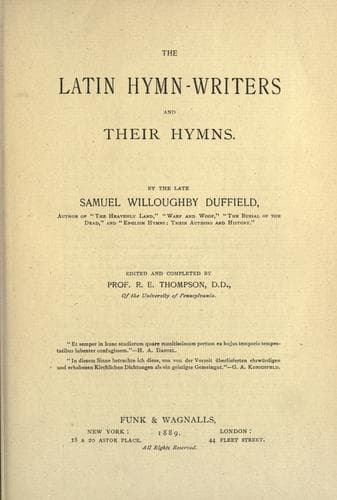
The Latin Hymn-writers and Their HymnsDuffield, Samuel Willoughby
Religion
The Latin Hymn-writers and Their Hymns
Duffield, Samuel Willoughby
Hymns, Latin -- History and criticism
Of course it is infinitely harder to the translator who is restricted,
than to the composer who can eddy around his subject—led by the rhyme as
much and as freely as he will. And this is what Bernard always does. His
verses are ejaculations, desires, lamentations, longings—measured out by
the “leonine hexameter” which he employs. To show the beauty still
untranslated, as well as to exhibit more of the structure of the poem, I
append four of these lines:
“Pax ibi florida, pascua vivida, viva medulla,
Nulla molestia, nulla tragoedia, lacryma nulla.
O sacra potio, sacra refectio, pax animarum
O pius, O bonus, O placidus sonus, hymnus earum.”
Thus Englished, closely:
“Peace is there flourishing,
Pasture-land nourishing,
Fruitful forever.
There is no aching breast,
There is no breaking rest,
Tears are seen never.
O sacred draught of bliss!
Peace, like a waft of bliss!
Sustenance holy!
O dear and best of sounds,
Heard in the rest of sounds,
Hymned by the lowly!”
Or thus, less closely and more according to the spirit of the poem:
“Peace doth abide in thee;
None hath denied to thee
Fruitage undying.
Thou hast no weariness;
Naught of uncheeriness
Moves thee to sighing.
Draught of the stream of life,
Joy of the dream of life,
Peace of the spirit!
Sacred and holy hymns,
Placid and lowly hymns,
Thou dost inherit!”
So strange and subtle is the charm of this marvellous poem, with its
abrupt and startling rhythm, that it affects me even yet, though I have
but swept my fingers lightly over a single chord. I seem to myself to
have again taken into my hand the old familiar harp, whose strings I
have often struck in times of darkness or of depression of soul, and to
be tuning it once more to the heavenly harmony which the old monk tried
to catch. Perhaps some day, when the clouds are removed, I shall see
him, and understand even better than now the glory that lit his lonely
cell, and made him feel that
“Earth looks so little and so low
When faith shines full and bright.”
CHAPTER XXII.
ADAM OF ST. VICTOR.
Public-domain text, read in full here on John Shaqi.
Reviews
Reviews
No reviews yet
Be the first to share your thoughts on this work.
Elsewhere in the archive
Join the Discussion
Join the discussion
Sign in to leave a comment or review.
Sign InorCreate an account