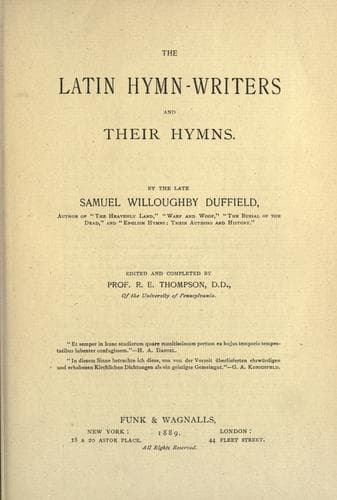
The Latin Hymn-writers and Their HymnsDuffield, Samuel Willoughby
Religion
The Latin Hymn-writers and Their Hymns
Duffield, Samuel Willoughby
Hymns, Latin -- History and criticism
I am not surprised that theologians should enjoy such a poet as Adam. He
is so terse, so dialectically subtle, so metaphysically accurate, so
allegorically copious. In a line he often makes a reference which his
editor struggles to catch in a foot-note a page long. And you must
comprehend the reference in order to comprehend the poem! As I read the
eulogy of Trench, I find him saying that when we remember Adam of St.
Victor’s theologic lore, his frequent and admirable use of Scripture,
his art and variety in versification, his “skill in conducting a story,”
and his own personal feeling which permeates his poems, we must put him
“foremost among the sacred Latin poets of the Middle Ages.” Dr. Neale,
too, calls him “the greatest of mediaeval poets.” And so, “what shall he
do that cometh after the King?” For, in spite of this mighty
commendation, and in spite of the praise which these didactic hymns have
obtained, _we cannot and do not sing any of them_. Even Dr. Neale cannot
make them singable, though he would probably do it if he could.
I must confess—and take the risk of being charged with stupidity and
ignorance—that I cannot place Adam of St. Victor where they have set
him. Southey’s ballads and poems are legion, as we know, and they are
learned beyond all cavilling; but they will not live like the two or
three little things of Motherwell. And Adam’s vast congeries of
sequences, composed for all the saints and festivals of the calendar,
cannot stand an instant against the sweetness of Bernard of Clairvaux,
or the grandeur of Peter Damiani’s judgment hymn. These others, it is
true, wrote less, but they wrote _subjectively_, and hence they appealed
to the heart of the Christian in every age. For _verse_ alone, however
skilful, is not _poetry_; and the celebration of saints and angels,
however beautifully accomplished, ministers nothing to “a mind
diseased.” We need to feel a genius which kindles its watch-fire in the
line of signal—as did Helena’s watchers between Jerusalem and
Constantinople. Then, as this flame flares up into the night, we know
that it speaks to us of the discovery of the true cross.
Public-domain text, read in full here on John Shaqi.
Reviews
Reviews
No reviews yet
Be the first to share your thoughts on this work.
Elsewhere in the archive
Join the Discussion
Join the discussion
Sign in to leave a comment or review.
Sign InorCreate an account