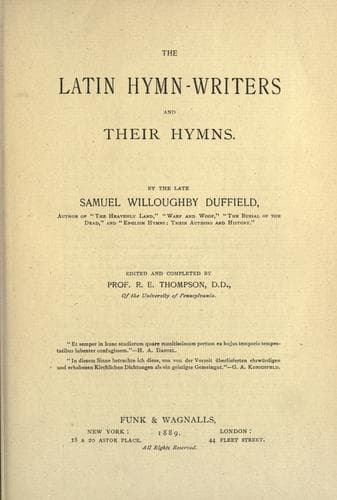
The Latin Hymn-writers and Their HymnsDuffield, Samuel Willoughby
Religion
The Latin Hymn-writers and Their Hymns
Duffield, Samuel Willoughby
Hymns, Latin -- History and criticism
I am thus compelled to dissent from the _cultus_ which has grown up
about this brilliant, epigrammatic, and altogether admirable Adam. For
he attracts by his obscurity and he surprises by his intricacy; and the
interest excited is that of the scholar and of the translator, rather
than that of the popular approval of the Christians of to-day. And I am
glad to support this opinion, not merely by the rather caustic comment
of Professor March, but by the word of Mrs. Charles, where she speaks of
“his elaborate system of Scriptural types occasionally chilling the
genuine fire of his verse into a catalogue of images.” And I must add,
for my own justification, that this “fire” is the fire of the orator,
and not altogether that of the poet. It is objective and not subjective;
for though there be two kinds of poetry in the world, we cannot doubt
which kind it is that “permanently pleases and takes commonly with all
classes of men”—for this was Aristotle’s unequalled definition.
It is time that we should take a glance at this laureate of St. Victor,
whose monumental plate of copper remained, down to the date of the first
Revolution, near the door of the choir in that ancient cloister. The
epitaph upon it was mainly drawn from his own work. It breathes the same
contempt of earth and derision of its vanities, which we find so common
in that age.
_“Vana salus hominis, vanus decor, omnia vana;_
_Inter vana nihil vanius est homine.”_
“Vain is the welfare of man and his fashion, for all things are
vanity;
And, in the midst of vanity, nothing is vainer than man.”
It was a later hand than his own which, after selecting those ten lines
from Adam’s own writings, added four very inferior verses to complete
the inscription. These state that:
“I who lie here, the unfortunate and wretched (_miser et miserabilis_)
Adam, ask one prayer as my highest reward: I have sinned; I confess; I
seek pardon; spare the contrite. Spare me, father; spare me, brethren;
spare me, God.”
He was born in Brittany, to the best of our information. He studied in
Paris, and finally entered the walls of St. Victor, never to leave it.
It is a very brief record, but it illustrates the monotony and dead
sameness of that mediaeval monastic life. The Dark Ages were mud-flats,
from which the tide had gone out. And yet I think that Adam of St.
Victor had another side to him, which Trench and Neale might well have
developed—a power of livelier rhythm than is often suspected. The little
stranded fish perchance gambolled a trifle in its small sea-water pool.
The poem which I quote is found in Migne and Gautier. It differs from
another sequence upon a similar theme—one which Dr. Neale has
translated. It is “The Praise of the Cross.”
Public-domain text, read in full here on John Shaqi.
Reviews
Reviews
No reviews yet
Be the first to share your thoughts on this work.
Elsewhere in the archive
Join the Discussion
Join the discussion
Sign in to leave a comment or review.
Sign InorCreate an account