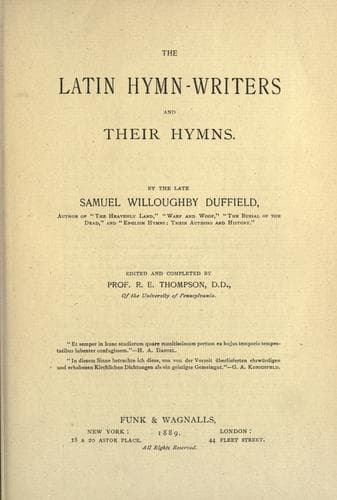
The Latin Hymn-writers and Their HymnsDuffield, Samuel Willoughby
Religion
The Latin Hymn-writers and Their Hymns
Duffield, Samuel Willoughby
Hymns, Latin -- History and criticism
Hymnologists have their favorites among the sacred singers of the Middle
Ages, but all concede the first place to the poet who gave the world the
_Dies Irae_, the great sequence or “prose” sung in the service for the
dead of the Latin Church. It has attracted more attention than any other
single hymn. Whole books have been written about it. It is indissolubly
associated in the history of music with Mozart’s wonderful “Requiem,”
and in that of literature with the concluding scenes of the first part
of “Faust.” More translations have been made of it than of any other
poem in the Latin language, or perhaps in any language. All Christendom
rejoices in it as a common treasure, the gift of God through a devout
Italian monk of the thirteenth century.
It was in an age full of vitality that this “hymn of the giants” was
written—the most interesting century in the history of Christendom,
Matthew Arnold says. In all directions we encounter the play or
collision of great forces. The Papacy, the Empire, the Crusades, the
Mendicant Orders, and even, in its way, the Inquisition, give evidence
of the working of a spirit of energy and movement, which places the
century in sharp contrast to the less explicit development which had
preceded, and the age of comparative exhaustion which followed. Nowhere
was this more visible than in the characters of the great Churchmen of
the thirteenth century. Popes like Innocent III. and Gregory IX.,
founders of orders like Dominic and Francis, theologians like Aquinas
and Bonaventura, may excite our admiration or our censure, but they are
men of such magnitude as are not to be found in other centuries in the
same number. They were live men, and they have made a lasting impression
upon the world by the force of their vitality.
Public-domain text, read in full here on John Shaqi.
Reviews
Reviews
No reviews yet
Be the first to share your thoughts on this work.
Elsewhere in the archive
Join the Discussion
Join the discussion
Sign in to leave a comment or review.
Sign InorCreate an account