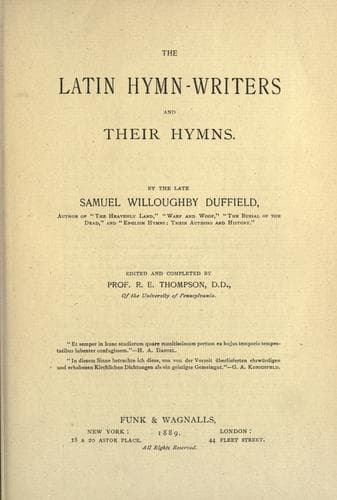
The Latin Hymn-writers and Their HymnsDuffield, Samuel Willoughby
Religion
The Latin Hymn-writers and Their Hymns
Duffield, Samuel Willoughby
Hymns, Latin -- History and criticism
Two of these, Aquinas and Bonaventura, we shall meet again as
hymn-writers. But first we have to deal with one whose chief claim to
recollection is a single great hymn. Thomas of Celano was an Italian at
a time when Italy was stirred by the great battle of Pope with Emperor
into an intellectual life, which was to culminate in Dante at the close
of the century. Exactly in its last year the writing of the _Divina
Commedia_ was to begin. The troubles of his time must have come very
close to Thomas. His native city of Celano, a town of the old Marsians,
was one of the first to suffer under the hand of Frederick II. In 1223
it was forced to capitulate by the Count of Acerra, Thomas of Aquinas,
the warlike uncle and namesake of the great theologian. The inhabitants
were compelled to leave their houses, taking all their movables, and the
place was burned to the ground, only the church of St John being left
standing among the ruins. The people, to punish their disloyalty to the
Emperor, were transported to Sicily, Malta, and Calabria, whence they
returned to rebuild their town after their enemy’s death. How old Thomas
was at the time of this calamity, and whether it had anything to do with
his becoming a monk of the Order of Francis of Assisi, we do not know.
But certainly it is not impossible that the spectacle of this _dies
irae_, when the sanctities of his boyhood’s home were left desolate, or
even the news of its occurrence in his absence, may have left a
permanent impression upon his mind, and may have suggested more or less
directly his great hymn.
Celano lay in the northern end of the Kingdom of Naples, as it was
afterward called, across the Apennines from Rome and slightly north of
it. It was not far from the northern boundary of Frederick’s hereditary
dominions, across which lay the Umbrian region, where Assisi is
situated. At some time and in some way Thomas made his way to Assisi,
and came under the influence of the wonderful man whose personality has
made the mountain town a place of pilgrimage even for those who are not
of the Latin communion.
Public-domain text, read in full here on John Shaqi.
Reviews
Reviews
No reviews yet
Be the first to share your thoughts on this work.
Elsewhere in the archive
Join the Discussion
Join the discussion
Sign in to leave a comment or review.
Sign InorCreate an account