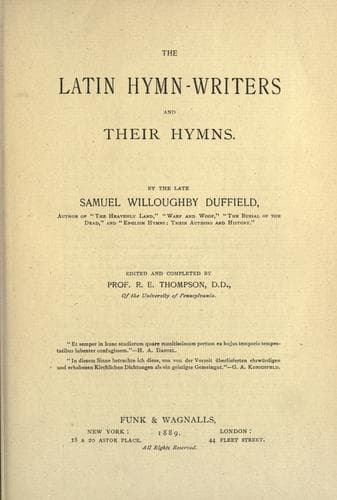
The Latin Hymn-writers and Their HymnsDuffield, Samuel Willoughby
Religion
The Latin Hymn-writers and Their Hymns
Duffield, Samuel Willoughby
Hymns, Latin -- History and criticism
Their sympathies as poets must have drawn them together. Francis, as
Joseph Goerres well says, was a troubadour as well as a saint. In his
youth he had won distinction as a singer of worldly songs in the
provençal French, which was then the language of literature in Northern
Italy. After his conversion he burst out singing the praises of God in
this same foreign and exotic tongue. But as he became more directly
interested in the welfare of his fellow-men, he began to use his gift of
song in his native Italian. How many of the poems that are printed under
his name are really his own, and how many are the work of his disciple,
Jacopone da Todi, is matter of dispute. But even Father Affo (1777), the
most negative of critics on this point, does not deny his authorship of
the wonderful “Song of the Sun,” also called the “Song of the
Creatures,” in which the childlike delight of the saint in God’s works
finds such charming expression, that Matthew Arnold has singled it out
as the utterance of what is most exquisite in the spirit of his century.
Thomas, too, it was known, had the poetic gift, and indeed was
recognized by his brethren as the man of most literary power in the
order. Upon him they laid the duty of compiling the founder’s biography,
and of writing the “legend” of his life, which should be read in the
breviary service on the day of his commemoration.
Yet he also was recognized as possessing practical gifts. The order had
spread into Germany as well as in the other directions of which Francis
had prophesied. The first attempts to establish it north of the Alps,
made in 1216, were not happy. The Italians sent on this mission knew
only one German word, “Ja!” “Are you heretics?” (_Sind Sie Ketzer?_) was
the first question put to them on Teutonic soil; and knowing nothing
else to say, they said “Ja!” So they were marched across the frontier
again in disgrace. But brethren better provided in the matter of their
Ollendorff had been sent five years later, and now Thomas of Celano was
one of those who had been selected for the German mission, to give
stability and unity to the work there. He was made “custos” of the
monasteries at Mainz, Worms and Koeln (Cologne), and even took charge of
the whole province when its head returned to Assisi. We find Thomas
himself back in Assisi by 1230, where Jordan, the “custos” of the
Thuringian monasteries, came to see him.
Public-domain text, read in full here on John Shaqi.
Reviews
Reviews
No reviews yet
Be the first to share your thoughts on this work.
Elsewhere in the archive
Join the Discussion
Join the discussion
Sign in to leave a comment or review.
Sign InorCreate an account