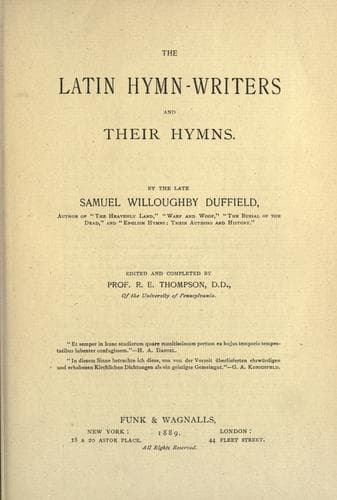
The Latin Hymn-writers and Their HymnsDuffield, Samuel Willoughby
Religion
The Latin Hymn-writers and Their Hymns
Duffield, Samuel Willoughby
Hymns, Latin -- History and criticism
Francis had died in 1226, but whether Thomas was actual witness of his
last days, or derived his knowledge of them from others, his is
recognized as the authentic account of the saint’s departure. His own
death is said to have occurred in 1255, but what events filled up the
meantime, besides the biographic labors we have mentioned, is not known.
Perhaps it was in those years that he composed his great sequence, as
his mind, when less directly brightened by the influence of his master,
would be more likely to revert to those trains of thought which
corresponded to his natural disposition. Possibly it was as his own life
was drawing to a close, and the shadows of the Great Day gathered nearer
him, that he poured out his soul in his great hymn—the greatest of all
hymns, unless we except the _Te Deum_.
Besides the _Dies Irae_, there are ascribed to Thomas two other
sequences—
_Fregit victor virtualis_
and
_Sanctitatis nova signa_,
both in commemoration of Francis. As the founder of the Minor Friars was
canonized two years after his death by Gregory IX., there was a demand
very early for the hymns of this character. And as there was no one
better fitted to write them than the poet who had known Francis so well,
and whom the Pope had directed to prepare a life of the saint, there is
no inherent improbability in the tradition which ascribes them to him.
But they do not take rank beside the _Dies Irae_. They are poems written
to order, not the spontaneous outpouring of the mind of the singer in
the presence of the overwhelming realities of the spiritual universe.
Public-domain text, read in full here on John Shaqi.
Reviews
Reviews
No reviews yet
Be the first to share your thoughts on this work.
Elsewhere in the archive
Join the Discussion
Join the discussion
Sign in to leave a comment or review.
Sign InorCreate an account