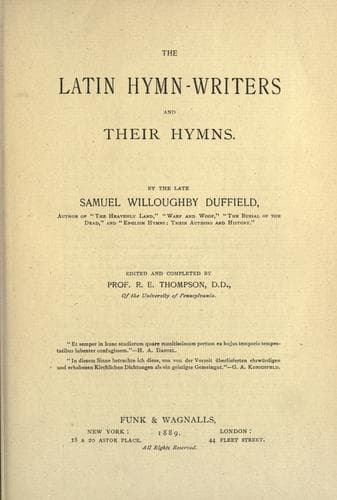
The Latin Hymn-writers and Their HymnsDuffield, Samuel Willoughby
Religion
The Latin Hymn-writers and Their Hymns
Duffield, Samuel Willoughby
Hymns, Latin -- History and criticism
There are no less than nine persons for whom the honor of the authorship
of the _Dies Irae_ has been claimed. Two of these are excluded as having
lived too early to have written a poem of its structure and metrical
character; they are Gregory the Great and Bernard of Clairvaux. Two
others, Augustinus Bugellensis (ob. 1490) and Felix Hammerlein (ob.
1457) are excluded by the fact that the hymn is mentioned in a work
written in 1285. This leaves four rivals to Thomas of Celano in his own
century, viz., John Bonaventura (ob. 1274), his brother Cardinal, Latino
Frangipani, a Dominican (ob. 1294), Humbert, a French Franciscan, who
became the fifth general of his order (ob. 1277), and Matthew of
Acqua-Sparta in Umbria, a Franciscan, who became Bishop of Albano and
cardinal (ob. 1302). But it is to be noticed that for not one of these
is there a witness earlier than the sixteenth century. The first and
last are named as having had the authorship ascribed to them by Luke
Wadding, the historian of the Franciscans in 1625; but he ascribes it to
Thomas of Celano. The other two are named by the Jesuit, Antonio
Possevino (1534-1611) and the Dominican, Leandro Alberti (1479-1552),
the latter, of course, claiming the hymn for the Dominican cardinal, as
to whom there is not the smallest evidence that he ever wrote any poetry
whatever. Besides this, the _Dies Irae_ is a Franciscan, not a Dominican
poem. It deals with the practical and the devotional, not the doctrinal
elements in religion. Had a Dominican written it, he would have been
anxious only for correct doctrinal statement.
Public-domain text, read in full here on John Shaqi.
Reviews
Reviews
No reviews yet
Be the first to share your thoughts on this work.
Elsewhere in the archive
Join the Discussion
Join the discussion
Sign in to leave a comment or review.
Sign InorCreate an account