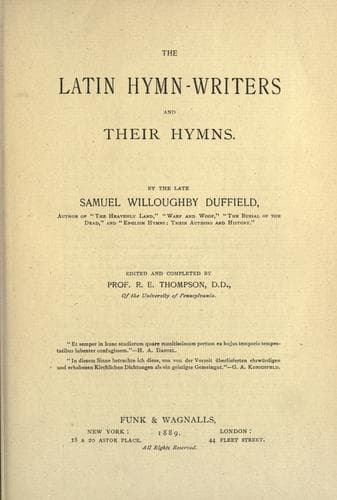
The Latin Hymn-writers and Their HymnsDuffield, Samuel Willoughby
Religion
The Latin Hymn-writers and Their Hymns
Duffield, Samuel Willoughby
Hymns, Latin -- History and criticism
The statement of Bartholomew of Pisa, that already in 1285 the _Dies
Irae_ was employed in the service for the dead, shows how early it made
its way into church use. In earlier times there was no sequence in that
service, for the reason that the “Hallelujah,” which the sequence always
followed, being a song of rejoicing, was not sung in the funeral
service. This enables us to form an opinion on the controversy as to
whether it was written directly for church use, or adapted for that
after being written as a meditation on the Day of Judgment for private
edification. It would seem most probable that it was the wonderful
beauty and power of the hymn which led the Church to break through its
rule as to the sequence following a Hallelujah necessarily. The _Dies
Irae_ was not written to fill a place, but when written it made a place
for itself.
This controversy connects itself with another as to the genuineness of
certain verses which are prefixed or added to the eighteen of the text
in the Missal. There are, in fact, three texts of the hymn: (1) That of
the Missal, which is generally followed, and will be found at the end of
this chapter. (2) That of the Mantuan marble tablet, which prefixes four
verses:
1. Cogita, anima fidelis,
Ad quid respondere velis
Christo venture de coelis.
2. Cum deposcit rationem
Ob boni omissionem,
Ob mali commissionem.
3. Dies illa, dies irae,
Quam conemur praevenire
Obviamque Deo ire.
4. Seria contritione,
Gratiae apprehensione,
Vitae emendatione.
After these come in the Mantuan text the first sixteen verses of the
Missal text, with slight and unimportant variations, but the seventeenth
and eighteenth are omitted, and the following conclusion substituted:
17. Consors ut beatitatis
Vivam cum justificatis,
In aevum aeternitatis. Amen.
(3) The Hammerlein text, so called because found among the manuscripts
of Felix Hammerlein after his death, which occurred about 1457. This
also contains the first sixteen verses of the Missal text, but with far
more variations than the Mantuan text shows, although not such as
commend themselves by their merits. Then it proceeds, altering and
expanding the seventeenth and eighteenth into three and adding five
more:
17. Oro supplex a ruinis,
Cor contritum quasi cinis;
Gere curam mei finis.
18. Lacrymosa die illa,
Cum resurget ex favilla
Tanquam ignis ex scintilla,
19. Judicandus homo reus,—
Hinc ergo parce Deus,
Esto semper adjutor meus.
20. Quando coeli sunt movendi,
Dies adsunt tunc tremendi,
Nullum tempus poenitendi.
21. Sed salvatis laeta dies;
Et damnatis nulla quies,
Sed daemonum effigies.
22. O tu Deus majestatis,
Alme candor Trinitatis,
Nunc conjunge cum beatis.
23. Vitam meam fac felicem,
Propter tuam genetricem,
Jesse florem et radicem.
24. Praesta nobis tunc levamen,
Dulce nostrum fac certamen,
Ut clamemus omnes: Amen!
Public-domain text, read in full here on John Shaqi.
Reviews
Reviews
No reviews yet
Be the first to share your thoughts on this work.
Elsewhere in the archive
Join the Discussion
Join the discussion
Sign in to leave a comment or review.
Sign InorCreate an account