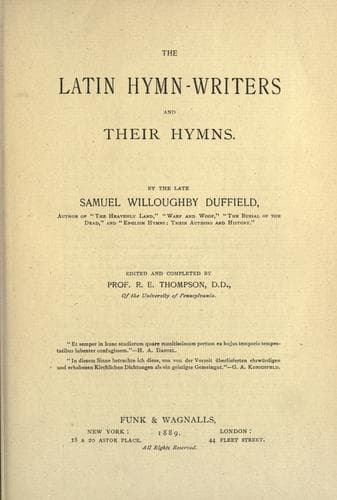
The Latin Hymn-writers and Their HymnsDuffield, Samuel Willoughby
Religion
The Latin Hymn-writers and Their Hymns
Duffield, Samuel Willoughby
Hymns, Latin -- History and criticism
That neither of these additions at the beginning and end are parts of
the original sequence, will be evident to any one who feels the
terseness and power of the original. They are feeble, lumbering
excrescences, and are fastened to it in such an external way as to
destroy the unity of the poem, if left as they stand. The text in the
Missal gives us a new conception of the powers of the Latin tongue. Its
wonderful wedding of sense to sound—the _u_ assonance in the second
stanza, the _o_ assonance in the third, and the _a_ and _i_ assonances
in the fourth, for instance—the sense of organ music that runs through
the hymn, even unaccompanied, as distinctly as through the opening
verses of Lowell’s “Vision of Sir Launfal,” and the transitions as
clearly marked in sound as in meaning from lofty adoration to pathetic
entreaty, impart a grandeur and dignity to the _Dies Irae_ which are
unique in this kind of writing. Then the wonderful adaptation of the
triple-rhyme to the theme—like blow following blow of hammer upon anvil,
as Daniel says—impresses every reader. But to all this the supplementary
verses add nothing.
Of the use of the hymn in literature I have spoken already. Sir Walter
Scott introduces a vigorous and characteristic version of a portion into
his “Lay of the Last Minstrel” (1805). Lockhart, writing of the great
Wizard’s death-bed, says of his unconscious and wandering utterances:
“Whatever we could follow him in was some fragment of the Bible, or some
petition of the Litany, or a verse of some psalm in the old Scotch
metrical version, or some of the magnificent hymns of the Romish ritual.
We very often heard distinctly the cadence of the _Dies Irae_.” So the
Earl of Roscommon, in the previous century, died repeating his own
version of the seventeenth stanza:
“Prostrate, my contrite heart I rend;
My God, my Father, and my Friend,
Do not forsake me in my end!”
Dr. Samuel Johnson never could repeat the tenth stanza without being
moved to tears—the stanza Dean Stanley quotes in his description of
Jacob’s Well. Goethe makes Gretchen in “Faust” faint with dismay and
horror as she hears it sung in the cathedral, and from that moment of
salutary pain she becomes another woman. Meinhold in his “Amber-Witch”
(_Die Bernsteinhexe_), represents the very same verses as bringing
comfort and assurance to a more stainless heroine in the hour of her
sorest distress. Carlyle shows us the Romanticist tragedian Werner
quoting the eighth stanza in his strange “last testament,” as his reason
for having written neither a defence nor an accusation of his life:
“With trembling I reflect that I myself shall first learn in its whole
terrific compass what I properly was, when these lines shall be read by
men; that is to say, in a point of time which for me will be no time; in
a condition in which all experience will for me be too late:
‘Rex tremendae majestatis,
Qui salvandos salvas gratis,
Salva me, fons pietatis!!!’”
Public-domain text, read in full here on John Shaqi.
Reviews
Reviews
No reviews yet
Be the first to share your thoughts on this work.
Elsewhere in the archive
Join the Discussion
Join the discussion
Sign in to leave a comment or review.
Sign InorCreate an account