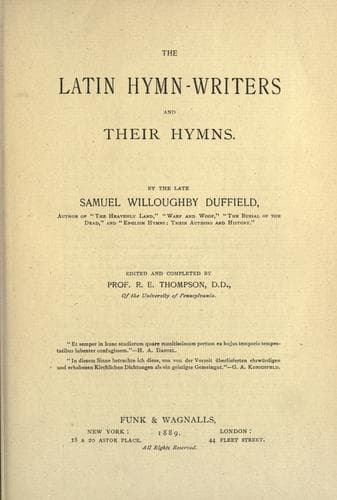
The Latin Hymn-writers and Their HymnsDuffield, Samuel Willoughby
Religion
The Latin Hymn-writers and Their Hymns
Duffield, Samuel Willoughby
Hymns, Latin -- History and criticism
In point of numbers at least America surpasses England and approaches
Germany. Since 1841, when two anonymous versions appeared in this
country, there have been at least ninety-six complete versions by
American translators, bringing the total of enumerated versions in the
language up to one hundred and fifty-four. Of American translators may
be named William R. Williams (1843), H. H. Brownell (1847), Abraham
Coles (1847 and later), William G. Dix (1852), S. Dryden Phelps (1855),
John A. Dix (1863 and 1875), Marshall H. Bright (1866), Edward Slosson
(1866), E. C. Benedict (1867), Margaret J. Preston (1868), Philip Schaff
(1868), Samuel W. Duffield (1870 and later), John Anketell (1873),
Charles W. Elliot (1881), Henry C. Lea (1882), M. W. Stryker (1883), H.
L. Hastings (1886), and W. S. McKenzie (1887). This certainly, both by
the length of the list and the weight of many of the names, constitutes
a tribute to the power of the _Dies Irae_ such as never has been offered
to any other hymn! Only Luther’s _Ein’ feste Burg_, of which there are
eighty-one versions in English alone, can compare with it.[13]
Of these English versions, those by Rev. W. J. Irons and Dean Stanley in
England, and those of General John A. Dix and Mr. Edward Slosson in
America, have enjoyed the most popularity. They certainly are excellent,
but every translator seems somewhere to fail of complete success. Nor do
those who have returned again and again to the attempt seem to
accomplish their own ideal of a perfect translation. Dr. Abraham Coles,
who has made some sixteen or seventeen renderings, is no better off than
when he began. Nor do I think my own sixth version has carried me one
inch beyond my first. The truth is that not even the _Pange lingua
gloriosi_, which Dr. Neale calls the most difficult of poems, is in this
respect the equal of this alluring and baffling hymn. But the reader,
who has had no access to the hymn except through the poorest version,
has the means to discern the fact that in it a great mind utters itself
worthily on one of the greatest of themes.
It happened to me once to enter a crowded church, where presently a
distinguished German divine arose to speak. Others had addressed the
audience in English; but he, turning to his fellow-countrymen, began to
pour forth a trumpet-strain of lofty eloquence in his native tongue. He
spoke of the “better valley,” of a happy and peaceful land. He seemed to
see its broad and gentle river and to hear the chiming of its Sabbath
bells. He peopled the air with its lovely citizens and created about us
the presence of its glorious joy. Faintly and brokenly, as now and then
he uttered some familiar words, I could catch glimpses of that _besseres
Thal_, and its brightness and beauty, and the awe of its holy calmness
came upon me—upon me, the stranger and the foreigner, in whose speech no
word was said.
Public-domain text, read in full here on John Shaqi.
Reviews
Reviews
No reviews yet
Be the first to share your thoughts on this work.
Elsewhere in the archive
Join the Discussion
Join the discussion
Sign in to leave a comment or review.
Sign InorCreate an account