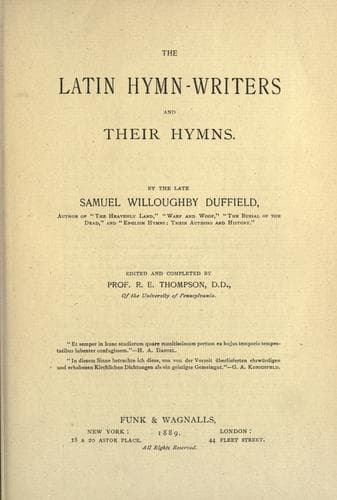
The Latin Hymn-writers and Their HymnsDuffield, Samuel Willoughby
Religion
The Latin Hymn-writers and Their Hymns
Duffield, Samuel Willoughby
Hymns, Latin -- History and criticism
Justus Kerner, in his _Wahnsinnige Brüder_, depicts the overwhelming
power of the hymn upon minds hardened by long continuance in sin, but
suddenly awakened to reflection by its thunders of the Day of Reckoning.
Daniel well compares it to the picture of the Day of Judgment, which was
the means of converting the King of the Bulgars to Christianity.
The translations of our hymn into modern languages, especially into
German and English, have been numbered by the hundred. Partly no doubt
this is due to the entirely Evangelical type of its doctrine, its
freedom from Mariolatry, its exaltation of divine mercy above human
merit, and its picture of the soul’s free access to God without the
intervention of Church and priest. Lisco (1840 and 1843) was able to
specify eighty-seven German versions. Michael (1866) brought this number
up to ninety, of which sixty-two are both complete and exact; and Dr.
Philip Schaff says he can increase the list beyond a hundred without
exhausting the number. Among the German translators are Andreas Gryphius
(1650), A. W. Schlegel (1802), J. G. Fichte (1813), A. L. Follen (1819),
J. F. von Meyer (1824), Claus Harms (1828), J. Emmanuel Veith (1829), C.
J. C. Bunsen (1833), H. A. Daniel (1839), F. G. Lisco (1840), besides
partial versions by J. G. von Herder (1802) and J. H. von Wessenberg
(1820).
The translations into English begin with one by Joshua Sylvester in
1621, that of Richard Crashaw in 1646 coming second. There are four of
that century and two of the next, the most notable being the Earl of
Roscommon’s in 1717. In the first thirty years of the nineteenth century
there are but four, the notable being the partial version by Sir Walter
Scott in 1805, and Macaulay’s in 1826. Since Isaac Williams published
his in 1831, there has been a steady succession of versions, bringing
the number for the United Kingdom in this century up to fifty-one. Of
these the most noteworthy are by John Chandler (1837), Henry Alford
(1844), Richard C. Trench (1844), William J. Irons (1848), Edward
Caswall (1849), Frederick G. Lee (1851), John Mason Neale (1851),
William Bright (1858), Elizabeth R. Charles (1858), Herbert Kynaston
(1862), Richard H. Hutton (1868), Dean Stanley (1868), William C. Dix
(1871), and Hamilton McGill (1876).
Public-domain text, read in full here on John Shaqi.
Reviews
Reviews
No reviews yet
Be the first to share your thoughts on this work.
Elsewhere in the archive
Join the Discussion
Join the discussion
Sign in to leave a comment or review.
Sign InorCreate an account