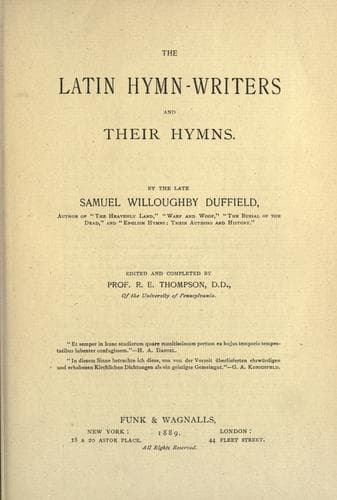
The Latin Hymn-writers and Their HymnsDuffield, Samuel Willoughby
Religion
The Latin Hymn-writers and Their Hymns
Duffield, Samuel Willoughby
Hymns, Latin -- History and criticism
order, and possibly to rise to the dignity of the _Dux et Princeps
omnium Abbatum et Religiosorum_, the Abbot of Monte Casino. But the
Mendicant orders were affairs of yesterday, with all the rawness if also
the effusive enthusiasm of youth. Francis of Assisi died within a year
of Thomas’s birth; Dominic, five years earlier. And the mendicant mode
of life was most offensive to the proud Italian nobles, who must have
recoiled from the idea that one of their race should carry the beggar’s
wallet in his turn, and live always upon alms. In this respect the
requirements of the orders were far stricter and more humiliating than
in later times, when the practice, if not the rule, was relaxed. Those
who were unaffected by their enthusiasm thought of the Mendicants as the
average man thinks of the Salvation Army, or thought of the Methodists
at the middle of the last century.
No notice was sent to Aquino of the step Thomas had taken. The monks
always had their share of the wisdom of the serpent, and they were to
show it in this case. But some of the vassals of the family had
recognized the young novice under his Dominican garb on the streets of
Naples or in the church; and through them the news reached his family.
Landulf seems to have been dead; I can find no mention of him later than
1229. But the Countess Theodora hastened, with all a man’s energy, to
rescue her son from the career of a mendicant. The friars learned of her
coming and hurried their novice off to Rome, and to Rome his mother
pursued him. To avoid her he was sent forward to France, but he had to
pass the lines of the imperial army then engaged in the war with the
Lombards. The influence of the powerful Ghibelline family roused the
vigilance of the imperial authorities. At Acquapendente, on the
frontiers of Tuscany, Thomas and the friars who escorted him were
arrested, and the young noble was sent back to his family at Aquino.
Every means, foul as well as fair, seems to have been used to break him
from his purpose to join the Dominicans, while he remained a prisoner at
Aquino, or in some of the mountain castles of the family. But Thomas was
assured of his vocation, and he had a fund of obstinacy in his character
which showed to good purpose. It is said that the Pope interfered in his
behalf, but this is hardly probable, as the Pope was waging war at the
time on the Emperor and his vassals, the Lords of Aquino. At last the
countess and her children abandoned the attempt to influence him, and at
least connived at his escape to Naples, where he took the vows of
obedience, celibacy, and poverty, which sealed his connection with the
Dominican order, in 1243.
Public-domain text, read in full here on John Shaqi.
Reviews
Reviews
No reviews yet
Be the first to share your thoughts on this work.
Elsewhere in the archive
Join the Discussion
Join the discussion
Sign in to leave a comment or review.
Sign InorCreate an account