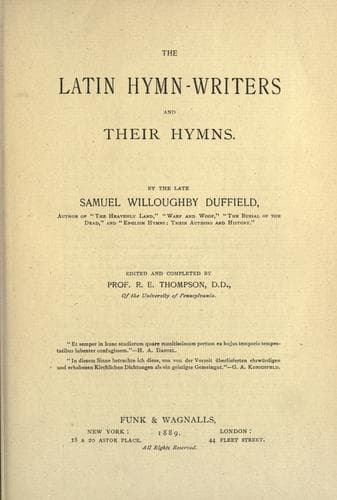
The Latin Hymn-writers and Their HymnsDuffield, Samuel Willoughby
Religion
The Latin Hymn-writers and Their Hymns
Duffield, Samuel Willoughby
Hymns, Latin -- History and criticism
We have looked at this step through the eyes of his family, and seen its
offensiveness. But if we regard it more impartially, we are impressed
with its wisdom. It was among the Dominicans, not the Benedictines, that
Thomas could serve his day and generation the best. The Benedictines, in
the new age which the era of the Crusades opened to Europe, had fallen
behind the times. It was because of this that that century saw the rise
of the two great orders founded by Dominic and by Francis, and their
rapid growth, until “a handful of corn on the top of the mountains”
shook like the forests which clothe Lebanon. The Dominican order was
still in the blossom of youth; the Benedictine had rather “gone to
seed.” Thomas felt the difference when he met the Dominicans as
professors of theology in the Studium at Naples. Scholarship rather than
thought had been the strong point with the Benedictines. They would be
apt to meet the questions which welled up in the mind of the eager youth
by an inapposite quotation from some Church father, or to repress them
altogether, as tending to vanity. What, indeed, could Abbot Landulf and
his brethren on the hill-top do with a deep-eyed boy, who went from one
to another with the question, “What _is_ God?” But at Naples, and in
contact with the more lively intellectual life of his age, his acute and
alert intellect found a satisfaction and an encouragement which the
Benedictines could not give him. He was encouraged to ask questions
instead of being snubbed. There were opened to him vistas of research
and speculation, which could not but attract a hungry and active mind
like his. The Dominicans were the order which had undertaken to face and
answer the questions of the age, and in Thomas these questions were
craving a solution. What wonder if he fell in love with the preachers,
and they with him! They discovered what capacity lay in the young noble,
and knew that they had better use for him than his hum-drum uncle on the
hills and among the hawks. And any scruples as to his admission to the
novitiate without the consent or against the will of his family were set
aside by the belief that his “vocation” was directly from God, and
therefore set aside all merely human authority.
Public-domain text, read in full here on John Shaqi.
Reviews
Reviews
No reviews yet
Be the first to share your thoughts on this work.
Elsewhere in the archive
Join the Discussion
Join the discussion
Sign in to leave a comment or review.
Sign InorCreate an account