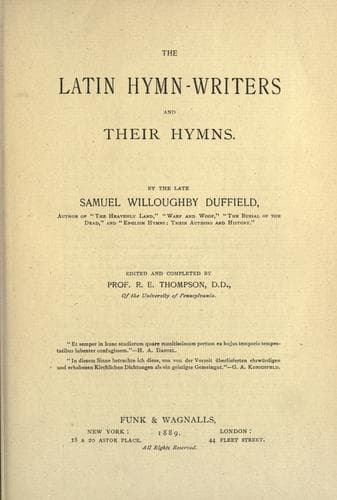
The Latin Hymn-writers and Their HymnsDuffield, Samuel Willoughby
Religion
The Latin Hymn-writers and Their Hymns
Duffield, Samuel Willoughby
Hymns, Latin -- History and criticism
In 1261 Michael Palaeologus, the Greek Emperor of Nicea, conquered
Constantinople, and thus put an end to the Latin Empire established by
the Fourth Crusade. But the wily Greek feared a general movement in
Latin Christendom to recover the city from him, and to gain time by
diplomacy he opened negotiations for the reconciliation of Eastern and
Western Christendom with Urban IV., then newly chosen to the papacy. The
Pope summoned Thomas Aquinas from Paris to Rome, to aid in these
negotiations by his erudition and acuteness. The subject was one into
which his previous studies had not conducted him, but a scholastic
philosopher must be prepared to write on any topic. _De omni scibili_
was his scope. So Thomas wrote his _Treatise against the Errors of the
Greeks_ (_Opusculum contra Errores Graecorum_) by the papal order. In
its preparation he became at once the victim and the instrument of one
of the most memorable forgeries in ecclesiastical literature. The
Dominicans had followed the Latin Empire into the East, but found
themselves at a loss for authorities to prove to the Greeks that the
autocratic papacy was a venerable, much less a primitive institution, of
the Christian Church. One of them conceived the bright thought of
manufacturing a supply. So he sent to Urban IV. a long _catena_ of
quotations from the Greek fathers, especially the two Cyrils and the
Council of Chalcedon, in which the papal authority and infallibility
were set forth with a boldness never used even in the West. The Pope
fully believed in their genuineness and handed them over to Thomas, who
incorporated many of them into his _opusculum_, besides using them in
his greater work. He knew too much about the teachings of the Greek
fathers not to be staggered by the quotations as to the Procession of
the Holy Spirit from the Father and the Son, and he expressed his doubts
in a letter to Urban. But he was not staggered by the forger’s showing
that the Greeks accepted the universal jurisdiction and infallible
authority of the papacy. In this way the notion of a universal
episcopate and an infallibility in the Bishop of Rome, from being the
audacious whim of a few canonists, passed into the dogmatic theology of
the Church, and came to be made an article of faith in our own time.
(See Acton-Döllinger-Huber’s book, _Janus, or the Pope and the Council_,
chap, iii., section 18.)
Public-domain text, read in full here on John Shaqi.
Reviews
Reviews
No reviews yet
Be the first to share your thoughts on this work.
Elsewhere in the archive
Join the Discussion
Join the discussion
Sign in to leave a comment or review.
Sign InorCreate an account