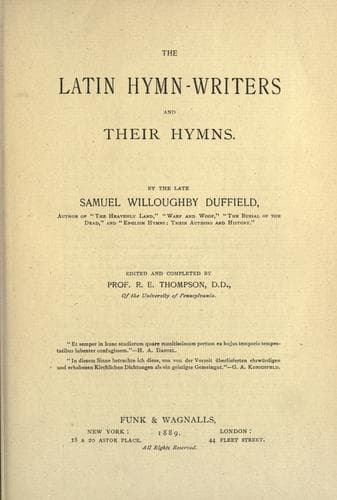
The Latin Hymn-writers and Their HymnsDuffield, Samuel Willoughby
Religion
The Latin Hymn-writers and Their Hymns
Duffield, Samuel Willoughby
Hymns, Latin -- History and criticism
From the masters the head of the school in St. Jacques Street was chosen
by the General of the Order, and naturally the choice fell on Thomas.
Usually the place was held for a year only, and its occupant then
transferred to some other field of labor. Thomas held it for four years,
lecturing, preaching at least every Lent in the adjacent church, and
exercising the discipline of the order over its students. The number who
heard his lectures must have been great. The school at Paris, unlike
that at Koeln, being a branch of the university, its lectures were open
to all comers, and the renown of the Italian who had been more than a
match for the ablest of the secular doctors would draw hearers. And
those who came once, if they had any love for the play of pure
intelligence and the fearless handling of great questions, would come
again. Thomas, with all his orthodoxy, was a pretty thorough
rationalist. He had full faith in the capacity of the human
understanding to deal fruitfully and safely with the deepest mysteries.
If his conclusions always are with the Church, it is not because he has
shrunk from attending to, and even suggesting, what might be said
against the doctrine under consideration. It is because he has satisfied
himself that the balance of logical argument, after all objections have
been weighed, is on the side of orthodoxy. In this respect his writings
represent the highest point reached by the rationalistic tendency in the
Middle Ages, just as Abelard represents its initiation. We find Duns
Scotus, his great Franciscan rival, shrinking from his rationalism, and
removing some of the mysteries of theology out of the field of logical
discussion.
Of course, his most devoted hearers were the young men of the order. Of
these some ninety were sent up every year from the schools in the
provinces outside France; and in addition to these picked men, who came
for the master’s degree, Paris had the training of all the students of
Northern France. Some of the former were from Spain, where the order was
engaged in combatting the Mohammedan doctors. Their needs drew Thomas’s
attention to the subject of his first systematic work, the _Summa contra
Gentiles_. Thomas puts himself upon the level of one who has no
Christian convictions, but argues simply from principles of philosophic
truth and of natural religion accepted by both parties. Besides these
and other literary labors he attended the annual General Chapters of his
order at Valenciennes in 1259, where he and Albrecht drew up the new
order of studies for the young Dominicans.
Public-domain text, read in full here on John Shaqi.
Reviews
Reviews
No reviews yet
Be the first to share your thoughts on this work.
Elsewhere in the archive
Join the Discussion
Join the discussion
Sign in to leave a comment or review.
Sign InorCreate an account