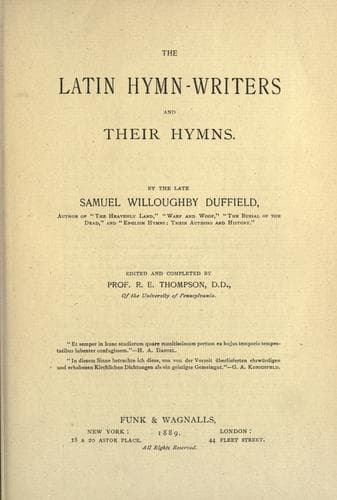
The Latin Hymn-writers and Their HymnsDuffield, Samuel Willoughby
Religion
The Latin Hymn-writers and Their Hymns
Duffield, Samuel Willoughby
Hymns, Latin -- History and criticism
The position of Thomas Aquinas in history is determined by the fact that
he is the greatest of the scholastic philosophers. What his master and
other earlier thinkers had attempted, he more nearly did than ever has
been done by any one else. He took the two great bodies of knowledge,
secular and sacred, and fused them into a system more nearly consistent
with itself than any other. On the one side was the encylopaedic
philosophy of Aristotle, and the parallel but less perfect tradition of
Platonic speculation; on the other the Scriptures, the dogmatic
decisions of the councils and popes, and the teachings of the recognized
authorities among the ecclesiastical writers, especially as these had
been summarized by Peter Lombard. To blend these into one great system
of theology, to subsidize the weapons of the Greek philosophy in defence
of Christian truth, and to draw the line with accuracy between what
reason can prove and faith accepts without proof—this was what he
undertook in the _Summa_. And never was a more acute intellect employed
on the great task of reconciling faith with reason. If he failed, it is
not because he shrank from anticipating any and every kind of objection
to the truths he was defending; his works are a perfect storehouse of
such objections. If he failed, it was not from any want of confidence in
the powers of the human mind to deal with the highest subjects of
thought. No modern rationalist ever surpassed him in that respect. He
failed because neither then nor now do the materials exist for such a
work, and because his truths lost and his errors gained force by being
worked into a system.
It would take a whole chapter even to describe the _Summa_. Of its three
parts, the first, concerning God, and the second concerning man, were
completed in the four years he gave to the work. In the third, which
treats of the God-Man, he got no farther than the ninetieth question,
and the discussion was completed by extracts from his commentary on
Peter Lombard. But the completed part contains nearly _two million_
Latin words, or with the supplement, two million one hundred thousand.
It is six times as large as Calvin’s _Institutio_, or four times as
large as the Latin Bible! And the _Summa_ fills only two of the
seventeen folios of his works, all written within the space of
twenty-six years by a man actively engaged in teaching, lecturing, and
advising popes and princes.
Public-domain text, read in full here on John Shaqi.
Reviews
Reviews
No reviews yet
Be the first to share your thoughts on this work.
Elsewhere in the archive
Join the Discussion
Join the discussion
Sign in to leave a comment or review.
Sign InorCreate an account