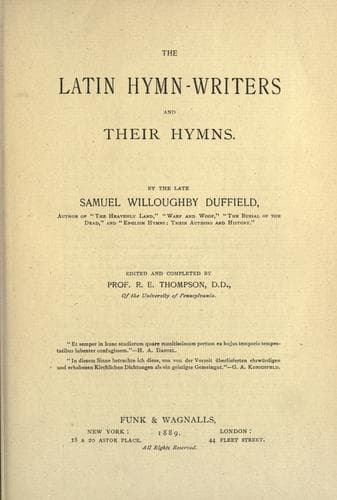
The Latin Hymn-writers and Their HymnsDuffield, Samuel Willoughby
Religion
The Latin Hymn-writers and Their Hymns
Duffield, Samuel Willoughby
Hymns, Latin -- History and criticism
That so much of the formative period of his life was spent in a
controversy, in which he was the applauded spokesman of a party whose
cause he regarded as the cause of God, could not but affect his
intellectual character. Professor Maurice thinks the delay in obtaining
the master’s degree worked in the same direction. The master in those
days was expected to pronounce decisions; those who had not attained
that rank were occupied in disputations only. “Thus our author was a
trained arguer,” and “the old habits remained with him when his
decisions were most accepted as authorities. From first to last he was
thinking of all that could be said on both sides of the question he was
discussing.” I believe that he was conscious of the narrowing and
dwarfing tendency of this habit of mind, even though he did not detect
the source of the evil. We read of his seeking to prepare himself for
his work by humble devotion. But to the last line of his last work the
controversial habit and attitude of mind clings to him. It is only in
his catechetical expositions, written before he left Koeln for Paris,
that you find a different atmosphere, and escape the heretic-crushing
Aristotelian dialectic of the scholastic disputant.
Even in his few hymns, which constitute his title to rank among the
sacred poets, he is the great scholastic doctor, with his eye on the
heresies which may distract the believer. He writes with the full
panoply under his singing robes. All his hymns are concerned with the
greatest of the Christian sacraments. It was in 1215, a year before the
confirmation of the Dominican Order, and twelve years before Thomas was
born, that the fourth Lateran Council made the transubstantiation of the
elements into the body and blood of Christ an article of faith. But a
Belgian ecstatic, Juliana of Liege, had a vision which called for a
special annual festival in honor of the mystery. Urban IV. complied with
this request in 1261, by requiring that the Thursday next after Trinity
Sunday should be observed as Corpus Christi Day. This involved the
preparation of an additional services for the Missal and Breviary, with
suitable prayers and hymns, and the work was laid upon Thomas. For the
Missal he wrote the sequence
_Lauda, Sion, Salvatorem;_
and for the Breviary the three hymns
_Pange, lingua, gloriosi Corporis mysterium,_
_Sacris solemniis juncta sint gaudia,_
and
_Verbum supernum prodiens, Nec Patris._
The Paris Breviary connects a fifth hymn of his with the same festival,
the
_Adoro Te devote, latens Deitas,_
assigning it for late (_serotinas_) services in the octave of Corpus
Christi. So Newman; but Daniel declares he finds it in none of the
breviaries of modern use, and in the missals only as a part of the
priest’s private preparation for saying Mass. Even this rank has not
been attained by the sixth hymn ascribed to him, the beautiful
_O Esca viatorum,_
Public-domain text, read in full here on John Shaqi.
Reviews
Reviews
No reviews yet
Be the first to share your thoughts on this work.
Elsewhere in the archive
Join the Discussion
Join the discussion
Sign in to leave a comment or review.
Sign InorCreate an account