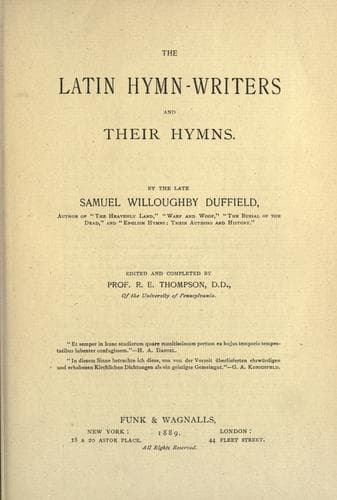
The Latin Hymn-writers and Their HymnsDuffield, Samuel Willoughby
Religion
The Latin Hymn-writers and Their Hymns
Duffield, Samuel Willoughby
Hymns, Latin -- History and criticism
Of the _Stabat Mater Dolorosa_, carried by the Flagellants into every
corner of Europe as they flogged themselves in public to its anthem, it
can be said that it is one of the very greatest hymns—if not actually
the greatest—of the Roman Catholic Church. The _Dies Irae_, the _Veni,
Sancte Spiritus_, and the Hymn of Bernard of Cluny, are catholic rather
than Roman. This is Roman rather than catholic. It is full of
Mariolatry. Take a stanza from a prose translation by way of example:
“Virgin of virgins, illustrious, be not now bitter to me, make me mourn
with thee, make me carry about the death of Christ, make me a sharer in
His passion, adoring His suffering.” And again: “O Christ, when I go
hence, give me, through Thy mother, to attain the palm of victory,” etc.
For this reason the Protestant metrical versions of the _Stabat Mater_
are few in number and generally accompanied by disclaimers of one kind
or another. Of course the music, on whose wings the hymn has now flown
world-wide, will need no word of mine. If the _Stabat Mater_ itself
receives commonly the second rank among hymns, it follows that Rossini,
Pergolesi, Palestrina and Haydn have not detracted from its glory. And
though in the terse language of one of our best hymnologists, we say,
“It is simple Mariolatry, most of it,” the human pathos of the verses
appeals strongly to those who refuse the added errors of the poem.
Of the _Stabat Mater Speciosa_ I confess to a decided doubt. It is in
the nature of a paraphrase, almost of a parody. It is unworthy of the
brain that formed the _Mater Dolorosa_, and the jester must have gone
beyond common folly if he descended to this imitation of himself. It is
more likely—and there is good ground for the opinion—that it is the work
of some later hand. Archbishop Trench, by the way, will not include
either of them in his collection.
Of the other writings of Jacoponus it may be interesting to say that he
composed hymns and satires in great abundance, both in Latin and in
Italian, which were collected by Franciscus Tressatus, a Minorite
brother, and published in seven books. The _Cur mundus militat_ (which
Wadding quotes at length) meets this editor’s highest praise. Of the
Italian poems we can say that they are now regarded by Symonds and
others as the fountain-head of Italian literature, and that they
contained many of the crude expressions of the common people mixed with
an elegance of phraseology to which Dante and Petrarch were accustoming
their mother tongue. Indeed, I know no other similar poet, unless it be
John Skelton, rector of “gloomy Dis” in England, who about a century
later shot the same kind of shafts at the same manner of target and with
much the same bitter, gibing wit.
Public-domain text, read in full here on John Shaqi.
Reviews
Reviews
No reviews yet
Be the first to share your thoughts on this work.
Elsewhere in the archive
Join the Discussion
Join the discussion
Sign in to leave a comment or review.
Sign InorCreate an account