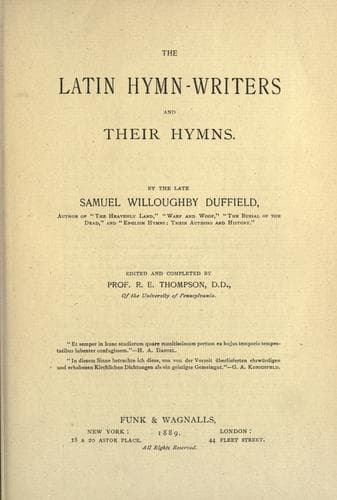
The Latin Hymn-writers and Their HymnsDuffield, Samuel Willoughby
Religion
The Latin Hymn-writers and Their Hymns
Duffield, Samuel Willoughby
Hymns, Latin -- History and criticism
It is strangely incongruous with this almost idyllic gentleness for us
to find such a man hanging a coveted bit of meat in his cell until the
odor of its putrefaction disgusted the rest of the monks, as well as put
an end to his own craving for the forbidden dainty. Then, too, we have
several other anecdotes of his grim humor and bold denunciation of sin.
Take, for example, the story told of his peculiar half-satirical conduct
in an instance which Wadding, the historian of the Franciscan Order,
relates with great gusto. A citizen of Todi, a relative of the poet, had
bought a pair of chickens, and not wishing to be inconvenienced by them,
he said to Jacoponus, “Take them and carry them for me, if you please; I
don’t care to burden myself with them.” To which Jacoponus answered,
“Trust me! I’ll carry your chickens home.” He then went direct to the
church of Fortunatus, in which his own monument was afterward placed,
and pulling up a gravestone he thrust the chickens in and replaced the
slab. The worthy citizen on his return of course found no chickens, and
therefore at once hunted out Jacoponus in the public square and
reproached him. “I took them to your house,” retorted the Franciscan.
“But I have just come from it and my wife says she has not seen you,”
the Tudescan asserted. Thereupon Jacoponus took him to the church and
having removed the stone, said to him: “Friend, isn’t that your home?”
The citizen, says Wadding, took his chickens, being a man evidently of
frugal mind, and, “not without fear, went his way absorbed in thought.”
This mad Solomon is at times so keen in his denunciations of the
corruption of the Church, and so evidently sincere in his own religion,
that more than one hymnologist has thought that his folly was largely
assumed as a guise under which he had greater freedom. The court fool
was a “chartered libertine” as to his language, and when we read the
epitaph of Jacoponus it seems as if he had reversed the saying of
Shakespeare and had stolen Satan’s livery to serve Heaven in. There is
no question but that this satirical freedom actually cost the poor
jester some considerable share of imprisonment, and this heightens the
likelihood that he was playing Brutus in order to abolish Caesar.
Boniface VIII., whom he had very plainly rebuked, was the one who
imprisoned him, and he was not released before the case—as he had indeed
predicted—was precisely reversed. Let me record my own conviction, based
upon the poem of which I append a translation, and upon the other facts
of his life, that this view of his career has much in its favor. Those
days and these are not to be compared in respect to liberty. Where
Bernard of Cluny swung his sling about his head and let the pebbles fly
to right and left with no very tangible result, Jacoponus took bow and
arrows and drove his shaft into the target. No one meddled with Bernard;
but Jacoponus, a century later, was a Tell for the ecclesiastical
Gessler.
Public-domain text, read in full here on John Shaqi.
Reviews
Reviews
No reviews yet
Be the first to share your thoughts on this work.
Elsewhere in the archive
Join the Discussion
Join the discussion
Sign in to leave a comment or review.
Sign InorCreate an account