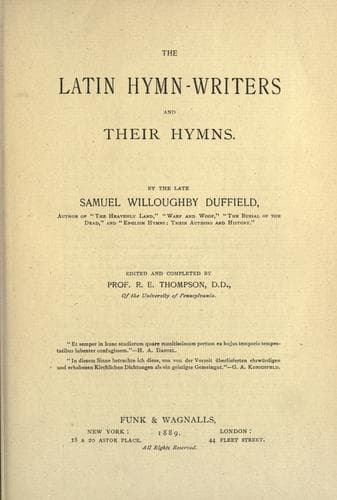
The Latin Hymn-writers and Their HymnsDuffield, Samuel Willoughby
Religion
The Latin Hymn-writers and Their Hymns
Duffield, Samuel Willoughby
Hymns, Latin -- History and criticism
We are not to imagine that these stirring verses, whether in Latin or in
Italian, went unnoticed. In the various productions of his muse the
humble monk enjoyed a popularity like that of Abelard. Numerous
manuscripts of his writings were scattered through Italy, France, and
Spain, and translations in these different languages helped to increase
his fame. Between the fifteenth and seventeenth centuries at least eight
editions appeared. But for critical purposes they are not so valuable as
might be supposed, since there are interpolations by other hands which
confuse and deter the investigator. They were supplemented in 1819 by
the publication of a number hitherto unknown, which were edited by
Alessandro da Mortara.
Of the Latin poetry ascribed to him the _Jesu dulcis memoria_ is
certainly Bernard’s, for Morel discovered it in an Einsiedeln MS. “older
than 1288.” There are two hymns—_Crux te, te volo conqueri_ and _Ave
regis angelorum_—of which we merely know the opening lines and have no
accessible originals. The _Verbum caro factum est_, the _Ave fuit prima
salus_, and the _Cur mundus militat_ are doubtless his own. The _Mater
Speciosa_ I take the liberty to discredit because of its gross
Latinity—a point which Ozanam concedes in spite of his belief in its
genuine character. The _Mater Dolorosa_ itself has not escaped question,
for Benedict XIV. declared it to be the work of Innocent III., to whom,
with about the same amount of truth, has also been attributed the _Veni,
Sancte Spiritus_.
In the year 1306, after imprisonment and excommunication had both passed
over his head and spent their force harmlessly, the aged Jacoponus drew
near his end. His companions urged him to ask for the final sacrament,
but he was in no haste. He would wait, he said, for John of Alvernia,
his true friend, and from his hands only would he receive it. They
considered this another proof of his untamed and rebellious nature, and
loudly lamented around his bed. But the dying man gave no heed to their
weakness. He raised himself upon his arm and with lifted face began to
chant the _Anima benedetta_—the song of a blessed soul. Scarcely had his
voice uttered the closing words ere two men were seen hastening across
the field. One was that very John of Alvernia, moved by some strange
presentiment to visit his friend. He entered the room and greeted
Jacoponus with a kiss of peace. Then he administered the sacrament of
the Eucharist. And thereupon the failing singer, his desire being at
last fulfilled, sang the _Jesu nostra fidanza_ and relapsed into silence
for a time. Then he exhorted those about him to live holy lives, and,
lifting his hands toward heaven, gently expired. It was on Christmas eve
and, in the neighboring church, the choir had just begun to chant the
_Gloria in Excelsis_.
Two hundred and ninety years after his death his tombstone and its
inscription were placed. The words, when rendered from Latin into
English, are these:
Public-domain text, read in full here on John Shaqi.
Reviews
Reviews
No reviews yet
Be the first to share your thoughts on this work.
Elsewhere in the archive
Join the Discussion
Join the discussion
Sign in to leave a comment or review.
Sign InorCreate an account