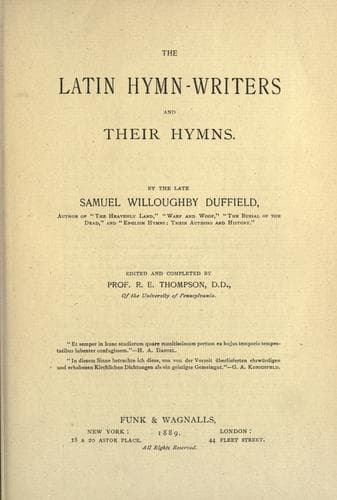
The Latin Hymn-writers and Their HymnsDuffield, Samuel Willoughby
Religion
The Latin Hymn-writers and Their Hymns
Duffield, Samuel Willoughby
Hymns, Latin -- History and criticism
“The bones of the blessed Jacoponus de Benedictis of Todi, who, a fool
for Christ’s sake, deluded the world by a new art and took heaven by
force.”
There is in the Lenox Gallery a small picture by Zamacois, which
represents a jester leaning against a head of Pan. The rude, broken bust
stands on an antique pedestal, its mouth, in its half-tragic, half-comic
curves, appearing to whisper into the ear of its companion. He,
scarlet-clad and with his bauble swinging idly in his hands, inclines
his head toward it and seems in a sad gravity to listen to its words.
There, indeed, do I see Jacoponus! The eager heart of the great
misunderstood, inconsistent, vain, and empty World tells him of its
nothingness—a broken and abandoned deity deserted in its garden of Eden.
An inexpressible sadness comes over me. Quietly I put by the _Stabat
Mater_; I do not love it!—but I close the page softly over the poor mad
prophet who rests his weary head on the steps of Solomon’s throne.
CHAPTER XXVI.
THOMAS À KEMPIS.
The contributions of Holland to the devotional poetry of Christendom
have not been extensive; but in the Middle Ages she could show several
Latin hymn-writers. The best known of these, however, is by far more
famous for his prose works. Thomas Hemerken, called afterward Thomas à
Kempis, was not by birth a Hollander. He was born in 1379 or 1380 at
Kempen, a small city in the diocese of Koeln (Cologne), not far from
what became the boundary line between the two nations. But in those
days, and, indeed, until the Peace of Westphalia, Holland, like
Switzerland, was reckoned a part of Germany. His father, John Hemerken,
was an artisan of the poorer class, probably a silversmith; and both his
parents were devout and God-fearing people. His elder brother John had
gone to Deventer to obtain an education, after the fashion of the times,
when boys wandered from city to city in search of instruction, and
supported themselves by singing, begging, and sometimes by thieving. But
at Deventer John had fallen in with some good people who had pity upon
these wandering scholars, and had made arrangements to furnish them
lodgings and copying-work in addition to what they would earn by singing
in the choir.
Public-domain text, read in full here on John Shaqi.
Reviews
Reviews
No reviews yet
Be the first to share your thoughts on this work.
Elsewhere in the archive
Join the Discussion
Join the discussion
Sign in to leave a comment or review.
Sign InorCreate an account