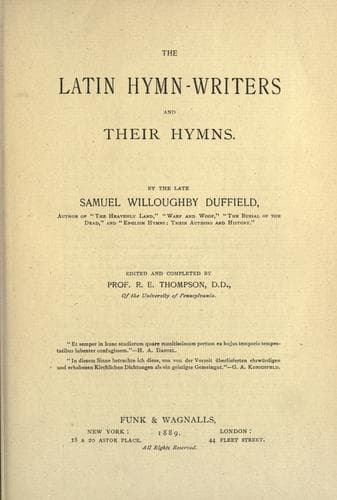
The Latin Hymn-writers and Their HymnsDuffield, Samuel Willoughby
Religion
The Latin Hymn-writers and Their Hymns
Duffield, Samuel Willoughby
Hymns, Latin -- History and criticism
The experience Christendom had had of the results of mendicancy led
Groote and his associates to base the new brotherhood on honest labor.
The shape this took reflects his own character. He was a great
book-lover—_semper avarus et peravarus librorum_, he says himself. When
in peril of his life in a storm by sea, he managed to save the six books
he had with him. He possessed a considerable library, and when the
brotherhood came to adopt the principle of community of goods, he and
the rest put their books into the common stock. And all who were able to
write were to labor in copying books for sale—the clergy in Latin, the
laymen in Dutch. It was this employment he extended to the poor scholars
of the Deventer school. Indeed, it seems not improbable that he began it
with them, and that the first brotherhood was composed of young friends
of this class, who had grown to manhood in this employment. It is
certain that in Deventer, in Zwolle, and for all we know in the other
cities where the brotherhood took root, near by the brother-house stood
a poor-scholars’ house, in which the boys attending the school of the
city were lodged, kept under discipline, and to some degree given work
also. But the Brethren of the Common Life were not an educating body, as
has been very generally supposed. They aimed only at saving boys from
the moral injury which too often attended their homeless life, at
keeping good discipline over them, and at imparting moral and religious
training. They aimed to do for the school-boys what the founders of
colleges in the universities of Oxford, Cambridge, and Paris tried to do
for the myriads of students who lived like vagrants in those seats of
learning.
But before Gerard Groote died the question was raised whether it would
not be advisable to establish a strictly monastic order of life for
those of the brethren who felt a vocation to it. To this he agreed, but
dissuaded his friends from adopting the severe rules of the Cistercians
and the Carthusians for the new order. Rather he suggested that of the
Canons Regular under the rule of St. Augustine as preferable, since it
would be more in keeping with the spirit of the brotherhood, and would
bind on no one too heavy burdens. This advice marks an advance upon
Dominic, Francis, and the “reformers” of the Benedictine and Mendicant
orders, in an evangelical direction. They all sought progress to
perfection in deeper austerity. In his case the preference perhaps was
caused by his friendship for the monastery of Canons Regular at
Groenendal, in Flanders, whose prior was Jan Rusbroek, the great Flemish
mystic. Gerard made several visits to Groenendal after his conversion,
and translated two of his friend’s books into Latin.
Public-domain text, read in full here on John Shaqi.
Reviews
Reviews
No reviews yet
Be the first to share your thoughts on this work.
Elsewhere in the archive
Join the Discussion
Join the discussion
Sign in to leave a comment or review.
Sign InorCreate an account