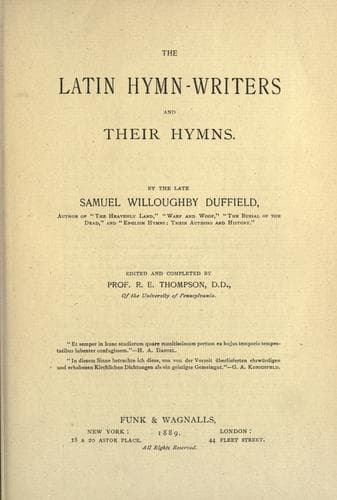
The Latin Hymn-writers and Their HymnsDuffield, Samuel Willoughby
Religion
The Latin Hymn-writers and Their Hymns
Duffield, Samuel Willoughby
Hymns, Latin -- History and criticism
The chief person in this group was Gerard Groote, a man of wealthy
family and some strange vicissitudes in life. He had studied at the
universities of Paris and Prague, and had taken minor orders to qualify
himself to hold the two canonries family influence secured to him, but
without giving any indication of a vocation to the sacred office. He
seems even to have led a dissolute life. Then a great change came over
him, chiefly through the influence of a friend of his youth named Henry
Eger, now the prior of a Cistercian convent at Munkhuisen. Gerard
resigned his benefices, and spent five years in a monastic retreat, from
which he emerged as a zealous preacher of the Gospel to the clergy and
people of what now is Holland, using both Latin and Dutch as occasion
served. He especially dwelt on the utter worldliness of that dreary
time, when priests, nobles, and tradesmen alike had lost all idea of
serving God and men, and had set up gain and pleasure as the recognized
ends of life. His sharp rebukes, and his exaltation of humility,
simplicity, and poverty, attracted the lower classes, but roused the
opposition of both the burghers and the Mendicants against him. After a
brief and stormy career he was silenced by the Archbishop of Utrecht,
and was obliged to find vent for his zeal in some other channel.
His purity and unworldliness had gathered around him, in his native
Deventer, men and women like-minded with him, who, according to the
tendency of the time, drifted naturally into a kind of monastic life.
Brother-houses and sister-houses were organized, and they became known
as the Brethren and Sisters of the Common Life. They took no vows, and
yet practised celibacy, common ownership and labor, and obedience to the
rector of the house. They adopted no common dress, but came to wear the
simplest gray robe of the same cut. Both laymen and clergy lived
together in the brother-houses, and each took his turn in the common
services of the brotherhood. They observed no canonical hours beyond
what the Church exacted of the priests among them. They assumed none of
the professions of the monks, and yet they realized the monkish ideal
better than did the monks themselves. The four principles which governed
Gerard’s own life and became the four corner-stones of this fraternity,
were “contempt of the world and of self, imitation of the lowly life of
Christ, good-will, and the grace of devoutness” (_contemptus mundi et
sui ipsius, imitatio humilis vitae Christi, bona voluntas, gratia
devotionis_). All this was summed up in the phrase _moderna devotio_,
used both by the brethren and the outside world to designate the
distinctive character of the order.
Public-domain text, read in full here on John Shaqi.
Reviews
Reviews
No reviews yet
Be the first to share your thoughts on this work.
Elsewhere in the archive
Join the Discussion
Join the discussion
Sign in to leave a comment or review.
Sign InorCreate an account