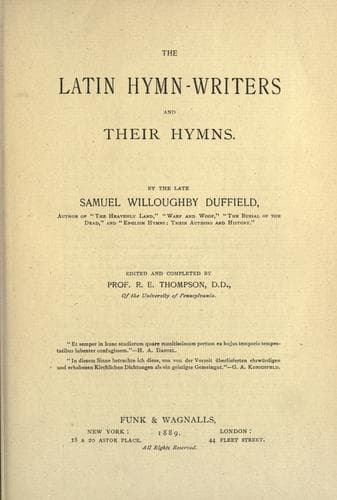
The Latin Hymn-writers and Their HymnsDuffield, Samuel Willoughby
Religion
The Latin Hymn-writers and Their Hymns
Duffield, Samuel Willoughby
Hymns, Latin -- History and criticism
The monastic life is studiously and intentionally monotonous. It aims at
the exclusion of all that gives zest and interest to ordinary existence,
and at the reduction of life’s employments to a routine. Its variety and
color are to be sought in the inner life of its members, and that of
Thomas was not wanting in these elements. If his inner experience be
reflected in his _Soliloquy of the Soul_, he passed through those
shifting seasons of gloom and gladness which characterize the experience
of an introverted religion. His religious character was formed on the
lines of the modern devotion, as defined by Gerard Groote, and as
reflected in the lives and the writings of Florens Radewinzoon, Gerard
Zerbolt, Johann Mande, Gerlach Peterszoon, and Johann Brinckerinck, the
earlier notable men of the brotherhood or of the Windesheim
congregation. His was not a bold and originative mind to strike out new
paths for himself. He had not even those gifts of practical
administration for which Florens, John à Kempis, and others of the order
were notable. Even when he had attained recognition as the most eminent
man at Agnietenberg, his brethren twice passed him by in selecting their
prior, and never gave him any dignity higher than the sub-priorate,
which probably was a sinecure. An early biographer goes so far as to
describe him as sitting silent whenever ordinary and worldly matters
were discussed, because of his ignorance of the very terms used at such
times. But this is an exaggeration. His _Chronicle of the Monastery of
Mt. St. Agnes_ shows him taking a mild and not unintelligent interest in
the secular side of the monastic life, and sharing the joy of his
brethren in the fine apple-crop or the large take of fish, and the like.
But this _Chronicle_ shows how limited his range of vision and interest.
He lived through the Papal Schism, the Asiatic conquests of Timour, the
Council of Constance, the Hussite wars, Henry the Fifth’s invasion of
France, the exploits of Jeanne d’Arc, the Council of Basle, the rise of
the Medici in Florence, and of the Duchy of Burgundy, the Council of
Florence, the exploits of Scanderberg and Hunyadi Janos, the Wars of the
Roses, the revival of letters, the invention of printing, the fall of
Constantinople, the Florentine Academy, the Portuguese discoveries in
the Atlantic, and much more that might be thought likely to be discussed
even within the walls of a Dutch monastery. But the record is silent as
to all these things; for the most part they are part of the doings of
that “world” which the disciples of the modern devotion trained
themselves to despise.
Public-domain text, read in full here on John Shaqi.
Reviews
Reviews
No reviews yet
Be the first to share your thoughts on this work.
Elsewhere in the archive