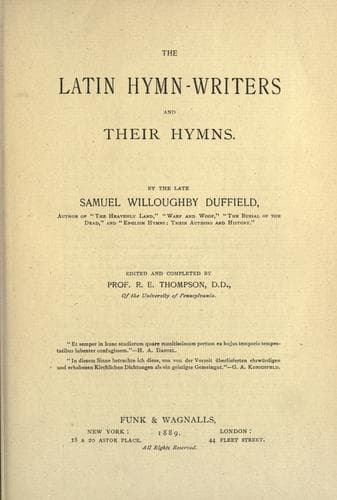
The Latin Hymn-writers and Their HymnsDuffield, Samuel Willoughby
Religion
The Latin Hymn-writers and Their Hymns
Duffield, Samuel Willoughby
Hymns, Latin -- History and criticism
No doubt the great question of the Papal Schism was of interest at
Agnietenberg, and also the two great councils which brought it to an
end. At the Council of Constance the Brethren of the Common Life were
arraigned by a zealous Mendicant as violating Church law by observing
the three rules of the monastic life without belonging to any recognized
order. But this Mendicant notion was declared heretical, thanks to two
great French doctors, Pierre d’Ailly and John Gerson, the second of whom
was to be associated so closely with Thomas in a famous controversy.
In 1427 the troubles of the outside world did reach the convent at
Agnietenberg and its associates. There had been a disputed election to
the princely diocese of Utrecht, then one of the largest and wealthiest
in Latin Christendom. The Pope recognized one candidate and the people
of the cities another. To break down their obstinacy the diocese was
laid under an interdict, which put an end to every act of public
worship. Thereupon the brotherhood and the order were given their choice
by the citizens, either to go on with their services as usual in church
and chapel, or to leave the diocese. With one consent they chose the
latter alternative, and in 1429 they distributed themselves among the
associated brother-houses and monasteries outside the diocese. The
twenty-four clerical and lay brethren of Agnietenberg found a home at
Luvenkerk in Friesland, in a disordered monastery which had been placed
under the rule of the Windesheim congregation, and which they used this
opportunity to reform. After three years of exile they were allowed to
return, a new Pope having yielded to the people. But Thomas did not
return so soon, for he had been called away to Arnheim to the death-bed
of his brother John, the brother he had found at Windesheim instead of
Deventer, and under whose priorship at Agnietenberg he took the vows.
In 1451 Deventer was visited by a great Churchman and notable thinker,
the Cardinal Nicolas of Cusa, who, like Thomas, was born east of what is
now the German frontier, but had received his schooling in Deventer,
where he learned to love and honor the Brethren of the Common Life. He
came now as papal legate to reform the abuses which had arisen in the
churches of Germany during the great schism; and when he came to his
loved Deventer he hastened to indicate his especial regard for his old
friends. He granted a special indulgence to both the brotherhood and the
order, and permitted the Windesheim congregation to establish a second
congregation, with equal privileges, to accommodate the rapidly
increasing number of convents of Canons Regular.
Public-domain text, read in full here on John Shaqi.
Reviews
Reviews
No reviews yet
Be the first to share your thoughts on this work.
Elsewhere in the archive
Join the Discussion
Join the discussion
Sign in to leave a comment or review.
Sign InorCreate an account