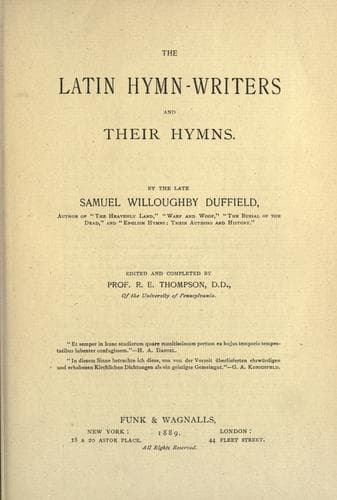
The Latin Hymn-writers and Their HymnsDuffield, Samuel Willoughby
Religion
The Latin Hymn-writers and Their Hymns
Duffield, Samuel Willoughby
Hymns, Latin -- History and criticism
a decided obstacle to the Reformation in Germany. When Rodriguez,
however, fell ill with an intermittent fever Xavier naturally occurred
to Loyola as the proper substitute. He therefore commissioned him for
the service, and the worn and wasted ascetic patched up his old coat,
said farewell to his friends, and having craved the Pope’s blessing, set
off from Rome with the Portuguese Ambassador, Mascarenhas, on March
16th, 1540. He started in such poverty that Loyola took his own
waistcoat and put it upon him, and he left behind him a written paper of
consecration to the society, expressing in it his desire that Loyola
should be its head, with Faber as alternate, and in which he took the
vows of poverty, chastity, and obedience to the order under whose
auspices he was going forth.
At the Portuguese Court in Lisbon, both Xavier and his companion were
diligent in their religious work. The morals of the capital were quite
reformed, and when it came time for the ships to sail to the East the
king would only spare Xavier and detained Rodriguez, by the advice of
Loyola, further to improve the affairs at home.
Xavier now sailed as Nuncio with papal commendation and with a poverty
of outfit which had its due effect upon his companions on board the
ship. The vessel itself was one of those great galleons of Spanish or
Portuguese origin, carrying often a thousand persons, and having from
four to seven decks. They were huge, unwieldy constructions and were
generally freighted with large amounts of rich merchandise. The course
was that pursued by Vasco da Gama—around the Cape of Good Hope and into
the Indian Ocean—and the voyage often lasted beyond eight months. It is
quaintly related of travellers by these precarious sea-paths that they
used to take their shrouds and winding-sheets with them in case they
died by the way.
The company on shipboard was as bad as the provisions, which were often
execrable. The peninsular sailors never had the art either of discipline
or of storing a ship and supplying what was needful for a voyage, as the
English sea-kings had it. Hence their vessels were great floating
caravansaries of human beings, full of the scum and offscouring of
society—with lords and ladies on the quarter-deck, and robbers and
murderers, harlots and gamblers down below. The crew was as prompt as
that of Jonah’s ship to cry upon their gods whenever the wind blew. Such
inventions as the ship’s pump, the chain-cable, and the bowsprit were
not known to them. And when we see Sir Richard Grenville in the little
Revenge fighting fifteen great Dons for as many hours, or Sir John
Hawkins beating his way out of the harbor of Vera Cruz when the _Jesus_
of Lubec was lost by Spanish treachery, we see how utterly cumbrous and
awkward these galleons were when compared with English vessels.
Public-domain text, read in full here on John Shaqi.
Reviews
Reviews
No reviews yet
Be the first to share your thoughts on this work.
Elsewhere in the archive
Join the Discussion
Join the discussion
Sign in to leave a comment or review.
Sign InorCreate an account