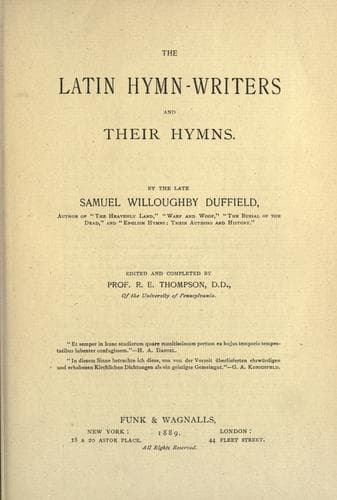
The Latin Hymn-writers and Their HymnsDuffield, Samuel Willoughby
Religion
The Latin Hymn-writers and Their Hymns
Duffield, Samuel Willoughby
Hymns, Latin -- History and criticism
It is worthy of note that this is not a Christian but a Jesuit act. It
is born of that exaggerated sentimentalism which chooses to go beyond
Christ and His apostles in its fallacious abnegation of self. But
wherever such acts are performed they rank as the marks of saintship and
as the _stigmata_ of a crucifixion which proudly places itself on the
same Golgotha with another and nobler cross. The records, not merely of
Xavier’s life, but of the lives of the saints, swarm with these
creeping, slimy frogs of Egypt, raised up by enchanters of the human
mind to make Pharaoh believe them to be equal to a far higher
Providence. And if we say little in these pages about such strange
developments and morbid growths of piety, it need not be forgotten that
they existed, and that they have been fostered and encouraged by the
Roman Church. The Breviary, for instance, commends a roll of
self-flagellators who used the whip upon their naked backs, and Xavier
heads the list with his iron flail. Cardinal Damiani, who wrote one of
our loveliest hymns, introduced this fashion of scourging in 1056, and
the holy nun, St. Theresa, after such exercises and an additional repose
upon a bed of thorns, was “accustomed to converse with God.” [_Aliquando
inter spinas volutaret sic Deum alloqui solita._] This topic, with its
allied suggestions, is altogether out of our present scope; but in order
to see Xavier as he was, we must appreciate to what extent his spirit
was subdued before his belief.
This was the man, tested and edged and tempered, to whom was now
committed the “salvation of the Indies.” It was during the papacy of
Paul III., the same Pope who excommunicated Henry VIII. of England. And
Xavier, who had practised many austerities both in life and in behavior,
was at first sent to Bologna, while Loyola, with Faber and Laynez, went
to Rome. It was subsequently at Rome that Xavier had his famous vision,
in which he awoke crying, “Yet more, O Lord, yet more!” for he fancied
that—as the Apostle Paul once did—he had beheld his future career and
was glorying in trials and persecutions. Especially did he often have a
dream in which he seemed to be carrying an Indian on his shoulders and
toiling with him over the roughest and hardest roads. And when at last
Govea, the Rector of the College of Ste. Barbe, happened to be in Rome,
Ignatius and his companions were brought by him to the notice of John
III. of Portugal, and the king desired to have six of them for use in
India. The Pope did not show any special desire to secure their
services, and when the question came up he referred it to Ignatius to
decide it as he pleased. That sagacious general objected to taking six
from ten and leaving only four to the rest of the world, for his
ambition now extended to the orb of the earth. He accordingly chose
Rodriguez and Bobadilla for India, men who were evidently well selected,
for the first became a great propagandist in Portugal, and the other was
Public-domain text, read in full here on John Shaqi.
Reviews
Reviews
No reviews yet
Be the first to share your thoughts on this work.
Elsewhere in the archive
Join the Discussion
Join the discussion
Sign in to leave a comment or review.
Sign InorCreate an account