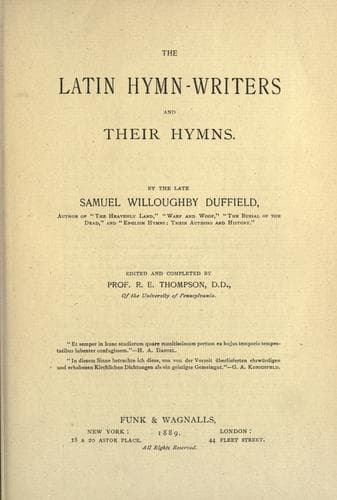
The Latin Hymn-writers and Their HymnsDuffield, Samuel Willoughby
Religion
The Latin Hymn-writers and Their Hymns
Duffield, Samuel Willoughby
Hymns, Latin -- History and criticism
Of these latter miracles it may be well to treat first. He is said to
have raised up Anthony Miranda, an Indian, who had been bitten by a
cobra; to have restored four dead persons at Travancore; to have
resuscitated a young girl in Japan and a child in Malacca, and to have
actually brought to the ship, alive and well, a lad who had fallen
overboard and been apparently lost. These incidents are related with
great gravity by the biographers and are accepted by the faithful as
being strictly true. To impugn them is as if one impugned the
Scriptures. Nevertheless there is an opening for scepticism in sundry
cases, and it may be that we shall do well to agree with the saint’s own
statement made to Doctor Diego Borba. “Ah, my Jesus!” he answered, “can
it be said that such a wretch as I have been able to raise the dead?
Surely, my dear Diego, you have not believed such folly? They brought a
young man to me whom they supposed to be dead; I commanded him to arise,
and the common people, who make a miracle of everything, gave out the
report that a dead man had been raised to life.” For the rest, we may
well believe that the same exaggeration and lack of scientific attention
to details have accompanied the various accounts, in some such manner as
appears in the little sketch of his personal characteristics which a
young Coquimban named Vaz has given to us. This enthusiastic admirer
describes his going afoot with a patched and faded garment and an old
black cloth hat. He took nothing from the rich or great unless he
applied it to the uses of the poor. He spoke languages fluently without
having learned them, and the crowds which flocked to hear him often
amounted to five or six thousand persons. He celebrated Mass in the open
air and preached from the branches of a tree when he had no other
pulpit. But of this healing of the sick and raising of the dead we are
not offered any better testimonials than the “Acts of his Canonization.”
Moreover, in a manner quite contrary to the experiences recorded in the
Gospels, these various miracles seem to be looked upon as the decisive
stroke of Christian policy. Upon their occurrence tribes and kingdoms
bow before the truth—a thing which did not happen at the tomb of
Lazarus, or before the walls of Nain, or within the house of Jairus. In
those cases the evangelists are content to tell us that the influence
was limited and confined to a very moderate area.
Public-domain text, read in full here on John Shaqi.
Reviews
Reviews
No reviews yet
Be the first to share your thoughts on this work.
Elsewhere in the archive
Join the Discussion
Join the discussion
Sign in to leave a comment or review.
Sign InorCreate an account