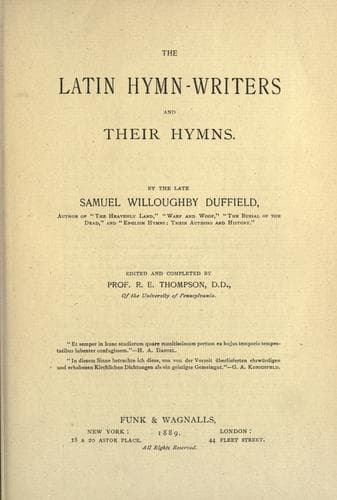
The Latin Hymn-writers and Their HymnsDuffield, Samuel Willoughby
Religion
The Latin Hymn-writers and Their Hymns
Duffield, Samuel Willoughby
Hymns, Latin -- History and criticism
Yet when we come to the cures of sick people, to the singular
predictions, and to the exalted condition into which Xavier must often
have been lifted, we must allow to the man a very high degree of
mystical and mesmeric and even clairvoyant power. We are wise enough
nowadays to observe the influence of a devoted personality, as when
Florence Nightingale traverses the hospital wards at Scutari, or David
Livingstone moves through savage tribes, to his dying hour at Lake
Lincoln. And when profound Church historians will not altogether
discredit the miracles of the Nicene Age which Ambrose and Augustine
relate, it causes us to be charitable even toward the miracles of
Bernard of Clairvaux, who recorded at large his own sense of uneasiness
respecting his power of curing the sick. But it somewhat relieves the
mind when the very chapters which relate these experiences of St.
Francis Xavier, mention also that a crab came out of the sea and brought
him his lost crucifix, and that after he had lived in a certain house
two children and a woman fell out of the window at different times and
received not so much as a single bruise, though they dropped from an
immense height upon the sea-wall. The credulity which includes such
palpable absurdities must surely have exposed itself to misstatements
and exaggerations in other directions.
It is far pleasanter for us to follow Xavier from his arrival at Goa,
May 6th, 1542, to the fisheries of Cape Comorin; thence to Malacca, and
so to the Banda Islands, Amboyna, and the Moluccas in 1546; again to
Malacca in 1547; to Ceylon and back to Goa in 1548, and finally to
Japan. In 1551 he planned a visit to China, but was disappointed, and at
the moment when he was hoping to accomplish a great purpose he died on
the island of San Chan, December 22d, 1552, at the early age of
forty-six years.
Closely studying himself and his methods we find him greatly and always
devout, his breviary, however, being his Bible. He prayed much and
labored incessantly. His charity to small and great was untiring. He
would go through the streets ringing a little bell and calling people to
come to religious worship, being frequently attended by a throng of
children who seem to have loved him and been beloved by him. He had
noble and sweet and modest traits in his character. But we often notice
the reliance he places on baptism—sometimes conferring this rite until
his arm dropped from weariness. And we observe how much of the wisdom of
the serpent can be discerned in his ways with the people whom he desired
to secure.
Public-domain text, read in full here on John Shaqi.
Reviews
Reviews
No reviews yet
Be the first to share your thoughts on this work.
Elsewhere in the archive
Join the Discussion
Join the discussion
Sign in to leave a comment or review.
Sign InorCreate an account