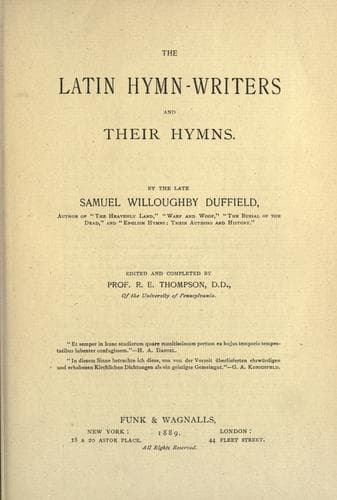
The Latin Hymn-writers and Their HymnsDuffield, Samuel Willoughby
Religion
The Latin Hymn-writers and Their Hymns
Duffield, Samuel Willoughby
Hymns, Latin -- History and criticism
But when we are asked to believe that the two Pereiras ever beheld him
elevated from the earth and actually transfigured, or when it is stated
that he lifted a great beam as though it had been a lath, we must be
excused for being doubtful of the statement. There is nothing more
destructive of religion than superstition, and nothing which kills faith
like credulity. Xavier, with all his false notions, was a most sincere
and even majestic figure—a hero of the faith, who shows us the power of
a thoroughly devoted spirit unencumbered by any earthly tie and
unobstructed by any earthly want. The entire self-immolation of this
career constitutes its amazing power. It is the missionary spirit
carried to its loftiest height.
Perhaps one of his most ingenious ways to secure the good-will of his
companions was by endeavoring to excite their benevolence. He would
encourage them to little acts of kindness and would repay these by
similar favors and services. Particularly he used persuasion rather than
denunciation, and personal efforts rather than general harangues. He was
“all things to all men,” going “privately to those of reputation,” as
Paul, his great model, was wont to do. He once wrote: “It is better to
do a little with peace than a great deal with turbulence and scandal.”
On April 14th, 1552, he set sail from Goa for Malacca where a pestilence
was raging. This delayed him awhile from China, and he was held back
still longer by the envious quarrellings of those who aspired to the
honor of attending him on his voyage. Xavier was reduced to the
necessity of producing the papal authority which constituted him Nuncio,
and of threatening with excommunication Don Alvaro Ataïde, the most
troublesome person. In addition to this difficulty he found himself
insulted and reviled in the open street, but accepted everything with
meekness and patience; which, however, did not prevent his finally
excommunicating Ataïde in the regular form. The vessel on which he
embarked was manned mostly by those in the pay of Ataïde, but he did not
shrink from the voyage. The voyage itself is decorated with many
legends, as might be expected. The saint is reported to have changed
salt water into fresh; to have rescued a child from death in a
miraculous manner, and to have become suddenly so much taller and larger
than those about him as to have been compelled to lower his arms when he
baptized the converts. They sailed from Chinchoo to San Chan, an island
in which the Portuguese had some trading privileges. It was here that
Xavier uttered a prediction which may serve to explain other singular
occurrences. He would seem to have possessed more than an ordinary
amount of medical skill in diagnosis, and looking earnestly upon an old
friend named Vellio, he bade him prepare for death whenever the wine he
drank _tasted bitter_. This might easily be from either of two
causes—poison, or a disorganized state of the system. And it is recorded
that the result fulfilled the prophecy.
Public-domain text, read in full here on John Shaqi.
Reviews
Reviews
No reviews yet
Be the first to share your thoughts on this work.
Elsewhere in the archive
Join the Discussion
Join the discussion
Sign in to leave a comment or review.
Sign InorCreate an account