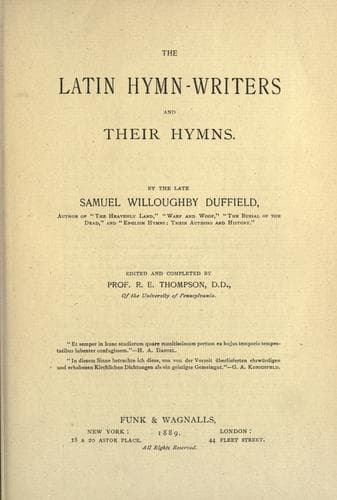
The Latin Hymn-writers and Their HymnsDuffield, Samuel Willoughby
Religion
The Latin Hymn-writers and Their Hymns
Duffield, Samuel Willoughby
Hymns, Latin -- History and criticism
Nor is there much doubt that
Vellio’s entire faith in the prediction helped on his death.
From San Chan Xavier now proposed to cross to China. He arranged to be
smuggled thither in a small boat, but the residents of San Chan, English
as well as Portuguese, became alarmed at the consequences which they
foresaw from this desperate scheme of intrusion into the forbidden
empire. And to crown all his woes he fell sick with a fever, from which,
however, he convalesced in a fortnight. He was now more anxious than
ever to go on with his project. But all the Portuguese ships had sailed
back again except the Santa Cruz, on which he had arrived. And now he
was truly deserted and neglected. He had scarcely the bare necessaries
of life, sometimes being deprived entirely of food. The sailors were
mostly in Ataïde’s pay and inimical to his purpose. At length he became
convinced that he would himself soon die, and so would often walk in
meditation and prayer by the seashore gazing toward the prohibited
coast.
At this time the young Chinese Anthony was his only hope as an
interpreter; and he was now deprived of the services of the merchant and
his son who had agreed to row him over to Canton. They had deserted him,
and only Anthony and one more young lad remained true to the dying
missionary. On November 20th the fever again seized him after he had
celebrated Mass. He was taken to a floating hospital, but being
disturbed by its motion he begged to be landed. This was done and he was
left upon the beach in the bleak wind. A poor Portuguese named George
Alvarez then took pity on him and removed him to his own hut of boughs
and straw. Rude medical care was given him, but on December 2d, about
two o’clock in the afternoon, he had reached the limit of his life. His
latest words were, _In te, Domine, speravi—non confundar in aeternum_—O
Lord, I have trusted in Thee, I shall never be confounded, world without
end.
Thus died Francis Xavier, for ten years and seven months a missionary in
the most dangerous and deadly regions of the earth. At the date of his
death he was of full and robust figure in spite of his privations, with
eyes of a bluish-gray, and hair that had changed its dark chestnut color
somewhat through his toils and sufferings. His forehead was broad, his
nose good, and his expression pleasant and affable. His beard, like his
hair, was thick, and his temperament was nearly a pure sanguine.
They buried him first at San Chan, then removed him to Goa, where in
solemn procession they conducted his mortal body to its final rest. But
his right arm was taken off and it is to be observed that “the saint
seems not to have been pleased at the amputation of his arm,” which,
however, did not prevent the Jesuit, General Claude Acquaviva, from
insisting upon the mutilation.
Public-domain text, read in full here on John Shaqi.
Reviews
Reviews
No reviews yet
Be the first to share your thoughts on this work.
Elsewhere in the archive
Join the Discussion
Join the discussion
Sign in to leave a comment or review.
Sign InorCreate an account