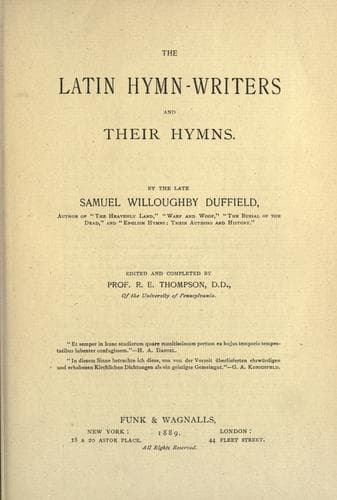
The Latin Hymn-writers and Their HymnsDuffield, Samuel Willoughby
Religion
The Latin Hymn-writers and Their Hymns
Duffield, Samuel Willoughby
Hymns, Latin -- History and criticism
With the development of a more fastidious taste, through the study of
the Latin classics as literary models, there arose in the sixteenth
century, and even before the Reformation, a demand for a reformation of
the Breviary. Besides its defects of form, such as violations of Latin
grammar, the constant use of terms which grated on the ears of the
humanists, and the use of hymns in which rhyme rather added to the
offence of want of correct metre, the contents of the Breviary were
found faulty by a critical age. The selections from the Fathers to be
read by way of homily were in some cases from spurious works; and the
narratives of saints’ lives for the days dedicated to them were not
always edifying, and in some cases palpably untrue. It became a
proverbial saying that a person lied like the second nocturn office of
the Breviary, that being the service in which these legends are found.
But the badness of the Latin and the metrical faults of the hymns
counted for quite as much with the critics of that day. We hear of a
cardinal warning a young cleric not to be too constant in reading his
Breviary, if he wished to preserve his ear for correct Latinity.
As might have been expected, it was the elegant Medicean Pope Leo X. who
first put his hand to the work of reform. He selected for this purpose
Zacharia Ferreri, Bishop of Guarda-Alfieri, a man of fine Latin
scholarship and some ability as a poet. By 1525 Ferreri had the hymns
for a new Breviary ready, and published them with the promise of the
Breviary itself on the title-page.[19] Clement VII., also of the house
of Medici, was Pope when the book appeared, and he authorized the
substitution of these new hymns for the old, but did not command this.
The book is furnished with an introduction by Marino Becichemi, a
forgotten humanist, who was then professor of eloquence at Padua. It is
worth quoting as exhibiting the attitude of the Renaissance to the
earlier Christian literature. He praises Ferreri as a shining light in
every kind of science, human and divine, prosaic and poetical. He cannot
say too much of the beauty of his style, its gravity and dignity, its
purity, its spontaneity and freedom from artificiality. “That his hymns
and odes, beyond all doubt, will secure him immortality, I need not
conceal. Certainly I have read nothing in Christian poets sweeter,
purer, terser, or brighter. How brief and how copious, each in its
place—how polished! Everywhere the stream flows in full channel with
that antique Roman mode of speech, except where of full purpose it turns
in another direction.” That means how Ciceronian Ferreri’s speech,
except where he remembers that he is a Christian poet and bishop writing
for Christian worshippers. “More than once have I exhorted him that it
belonged to the duty and dignity of his episcopal (_pontificii_) office
to make public these Church hymns.”
Public-domain text, read in full here on John Shaqi.
Reviews
Reviews
No reviews yet
Be the first to share your thoughts on this work.
Elsewhere in the archive
Join the Discussion
Join the discussion
Sign in to leave a comment or review.
Sign InorCreate an account