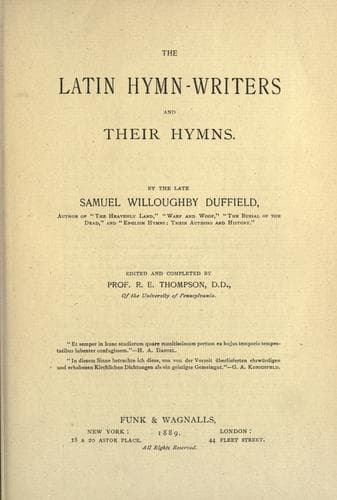
The Latin Hymn-writers and Their HymnsDuffield, Samuel Willoughby
Religion
The Latin Hymn-writers and Their Hymns
Duffield, Samuel Willoughby
Hymns, Latin -- History and criticism
“You know, my reader, what hymns they sing everywhere in the temples,
that they are almost all faulty, silly, full of barbarism, and composed
without reference to the number of feet or the quantity of the
syllables, so as to excite educated persons to laughter, and to bring
priests, if they are men of letters, to despise the services of the
Church. I say men of letters. As for those who are not, and who are the
gluttons of the Roman curia, or who have no wisdom, it is enough for
them to stand like dragons close by the sacred ark, or to drift about
like the clouds, to live like idle bellies, given over to the pursuit of
sleep, good living, sensual pleasures, and to gather up the money by
which they make themselves hucksters in religion and plunderers of the
Christian people and practice their deceits upon both gods and men
equally, until the vine of the Lord degenerates into a wild plant.”
The Italianized Greek would see no difference between a Tetzel and a
Ferreri. But there still were sincerely good people who relished the old
hymns better than the polished paganism of the Bishop of Guarda-Alfieri.
Ferreri’s hymns struck no root in spite of the favor of two Medicean
popes. They seem never to have reached a second edition. Their frankly
pagan vocabulary for the expression of Christian ideas seems to have
been too much for even the humanists.
Bishop Ferreri does not seem to have lived to prepare his shorter and
easier Breviary after the same elegant but unsuitable fashion as his
hymns. So Clement VII. put the preparation of a new Breviary into the
hands of another and a better man, Cardinal Francesco de Quiñonez. He
was a Spanish Franciscan, had been general of his order, and was made
Cardinal by Clement in acknowledgment of diplomatic services. He enjoyed
the confidence of the Emperor Charles V., and used it to rescue the Pope
from his detention in the Castle of San Angelo, when he was besieged
there after the taking of Rome by the Imperial troops in 1529. This is
hardly the kind of record which would lead us to look for a reformer
under the red hat of our cardinal. But, so far as the Breviary was
concerned, he proved himself too rigorous a reformer, if anything. His
work was governed by two leading principles. The first was to simplify
the services by dropping out those parts which had been added last. The
second was to use the space thus obtained to insert ampler Scripture
lessons and more Psalms, so that, as in earlier times, the Bible might
be read through once a year and the Psalter once a week. It is this last
feature which has elicited the praise of Protestant liturgists, and it
is known that the Breviary of Quiñonez furnished the basis for the
services of the Anglican Book of Common Prayer, excepting, of course,
the Communion Service. But unfortunately hymnologists are not able to
join in this praise. To get the Psalms said or sung through once a week,
he dealt nearly as ruthlessly with the hymns as if he were a Seceder.
Public-domain text, read in full here on John Shaqi.
Reviews
Reviews
No reviews yet
Be the first to share your thoughts on this work.
Elsewhere in the archive
Join the Discussion
Join the discussion
Sign in to leave a comment or review.
Sign InorCreate an account