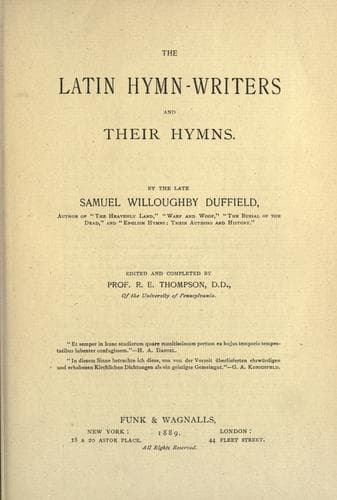
The Latin Hymn-writers and Their HymnsDuffield, Samuel Willoughby
Religion
The Latin Hymn-writers and Their Hymns
Duffield, Samuel Willoughby
Hymns, Latin -- History and criticism
The three revisers, all of them poets of some distinction, and the first
famous for his history of the wars in the Low Countries, had to steer a
middle course in the matter of revision. None of them were radical
humanists after the fashion of Zacharia Ferreri; that fashion, indeed,
had gone out with the rise of the counter-reformation and of the great
order to which they belonged. Yet in the matter of “metre and Latinity,”
of which Ferreri boasted on his title page a hundred years before, the
revival of classical scholarship had established a standard to which the
old hymns even of the Ambrosian period did not conform. The revisers
profess their anxiety to make as few changes as possible; but Pope
Urban, in his bull _Psalmodiam sanctam_ prefixed to the book, announces
that all the hymns—except the very few which made no pretension to
metrical form—had been conformed to the laws of prosody and of the Latin
tongue, those which could not be amended in any milder way being
rewritten throughout. Bartolomeo Gavanti, a member of the Commission of
Revision, but laboring in another department, tells us that more than
nine hundred alterations were made for the sake of correct metre, with
the result of changing the first lines of more than thirty of the
ninety-six hymns the Breviary then contained; that the three by Aquinas
on the sacrament, the _Ave Maris stella_, the _Custodes hominum_, and a
very few others, were left as they were.
This, then, is the genesis of the class of hymns designated in the
collections as traceable no farther back than the Roman Breviary. Some
of them are original, being the work of Silvius Antonianus, Bellarmine,
or Urban VIII. himself, or of authors of that age whose authorship has
not been traced. But the greater part are recasts of ancient hymns to
meet the demands of the humanist standards of metre and Latinity.
It is not easy to give a merely English reader any adequate idea of the
sort of changes by which Strada and his associates adapted the old hymns
to modern use. But for those who can read Latin some specimens are worth
giving. Take first the great sacramental hymn of the eighth or ninth
century:
Ad coenam Agni providi
Et stolis albis candidi,
Post transitum maris Rubri
Christo canamus principi,
Cujus corpus sanctissimum
In ara crucis torridum,
Cruore ejus roseo
Gustando vivimus Deo
Protecti paschae vespero
A devastante angelo
Erepti de durissimo
Pharaonis imperio.
Jam pascha nostrum Christus est
Qui immolatus agnus est,
Sinceritatis azyma
Caro ejus oblata est.
O vera digna hostia
Per quam fracta sunt tartara
Redempta plebs captivata,
Reddita vitae praemia
Cum surgit Christus tumulo
Victor redit de barathro,
Tyrannum trudens vinculo,
Et reserans paradisum
Quaesumus, auctor omnium
In hoc paschali gaudio:
Ab omni mortis impetu
Tuum defende populum.
Ad regias Agni dapes
Stolis amicti candidis
Post transitum maris Rubri
Christo canamus principi:
Public-domain text, read in full here on John Shaqi.
Reviews
Reviews
No reviews yet
Be the first to share your thoughts on this work.
Elsewhere in the archive
Join the Discussion
Join the discussion
Sign in to leave a comment or review.
Sign InorCreate an account