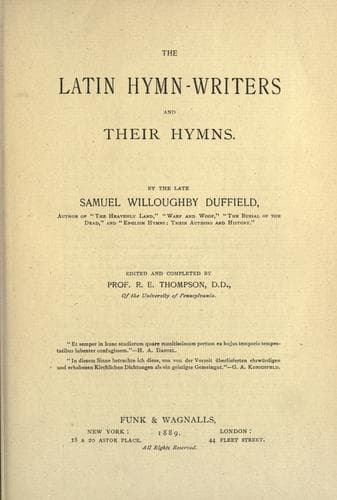
The Latin Hymn-writers and Their HymnsDuffield, Samuel Willoughby
Religion
The Latin Hymn-writers and Their Hymns
Duffield, Samuel Willoughby
Hymns, Latin -- History and criticism
His Breviary appeared in 1535,[20] and for thirty-three years its use
was permitted to ecclesiastics in their private recitation of the hours.
It appeared in a large number of editions in different parts of Europe,
so that its use must have been extensive. But it did not pass
unchallenged. The doctors of the Sorbonne at Paris hurried into the
arena with their condemnation of it before the ink was fully dry on the
first copies. They declared it a thing unheard of to introduce into
Church use a book which was the production of a single author, and he—as
they wrongly alleged—not even a member of any religious order.
Furthermore, he had so shortened and eviscerated the legends for the
saints’ days, besides omitting many, that nobody could tell what virtues
and what miracles entitled them to commemoration. Above all he had
omitted Peter Damiani’s Little Office of the Blessed Virgin! Much better
founded was the objection to the omission of parts long established in
use, such as the antiphons and many of the hymns. Here we must side with
the Sorbonne against Quiñonez.
It was not until 1568 that the present Roman Breviary appeared. When the
Council of Trent met in its final session in 1562, the first drafts of a
reformed Breviary and Missal were transmitted to the Fathers by Pius
IV.; but they were too busy with questions of discipline to do more than
return these with their approbation. The work was published by Pius V.
in July, 1568, and its use was made obligatory upon all dioceses which
had not had a Breviary of their own in use for two hundred years
previously. This is in substance the Breviary now in use throughout the
Roman Catholic Church. It underwent, however, two further revisions.
That under Clement VIII., finished in 1602, was by a commission in which
Cardinals Bellarmine, Baronius, and Silvius Antonianus were members.
That under Urban VIII., completed in 1631, concerns us more directly,
and especially the part of it which was effected by three learned
Jesuits: Famiano Strada, Hieronimo Petrucci, and Tarquinio Galucci, who
had in their hands the revision of the hymns.
Public-domain text, read in full here on John Shaqi.
Reviews
Reviews
No reviews yet
Be the first to share your thoughts on this work.
Elsewhere in the archive
Join the Discussion
Join the discussion
Sign in to leave a comment or review.
Sign InorCreate an account