The Latin Hymn-writers and Their Hymns — John Shaqi
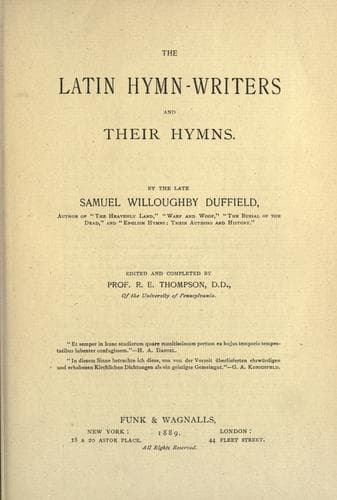
The Latin Hymn-writers and Their HymnsDuffield, Samuel Willoughby
Religion
The Latin Hymn-writers and Their Hymns
Duffield, Samuel Willoughby
Hymns, Latin -- History and criticism
Samuel Augustus Willoughby Duffield was born at Brooklyn, on September
24th, 1843. His family was of French Huguenot extraction (Du Field), and
found a home in the North of Ireland after the Revocation of the Edict
of Nantes. Between 1725 and 1730 George Duffield, his ancestor by five
removes, settled in Lancaster County, as one of the great Ulster
emigration which was flowing into Pennsylvania. His son George graduated
at Princeton, and after several pastorates was settled in Philadelphia
in the Pine Street church. He was an ardent patriot, chaplain in
Washington’s army, and Bishop White’s associate in the chaplaincy of the
Continental Congress. Of two sons who survived him, one became a
minister, while the other took a prominent part in public life. His
grandson, Rev. George Duffield, D.D. (1796-1868) was a leader of the New
School division of the Presbyterian Church, both before and after the
separation of 1837, and while pastor at Carlisle was arraigned for
unsound teaching in his work on _Regeneration_. “Barnes, Beman, and
Duffield” were the three names most offensive to the Aristarchuses of
orthodoxy in that time. He was married to a sister of Dr. George W.
Bethune. His son, generally known in our times as Dr. George Duffield,
Jr., to distinguish him from his father, was born in 1818 at Carlisle,
graduated at Yale College in 1837, and at Union Theological Seminary.
One of his pastorates was in Brooklyn, from 1840 to 1847, during which
his son, Samuel Augustus Willoughby, was born. He is best known as a
hymn-writer, two of his hymns being known and loved wherever the English
language is spoken. They are, “Blessed Saviour, Thee I love,” and “Stand
up, stand up for Jesus,” the latter being suggested by the dying words
of Dudley Tyng in 1858.
Samuel W. Duffield was of the sixth American generation of his family.
From his youth he was a young giant, with an inborn love of active
sports, quick in movement, and apparently incapable of fatigue. His mind
showed equal vigor and freshness, and he early developed a passion for
poetry. By his tenth year he had mastered Chaucer, in spite of
difficulties much more serious to beginners in those days than in our
own. And he very early began to find expression for his own ideas in
verse. He united with the Church at the age of thirteen, when his father
was a pastor in Philadelphia, being the only one who did so at the time,
so that the act was the result of personal decision and not of a revival
excitement. He graduated at Yale in 1863; and after teaching for a
while, he began the study of theology under the care of his grandfather
and his father. Not until after he had been licensed to preach, and had
had charge of a mission in Chicago, did he present himself as a student
in Union Theological Seminary.
Public-domain text, read in full here on John Shaqi.
Reviews
Reviews
No reviews yet
Be the first to share your thoughts on this work.
Join the Discussion
Join the discussion
Sign in to leave a comment or review.
Sign InorCreate an account