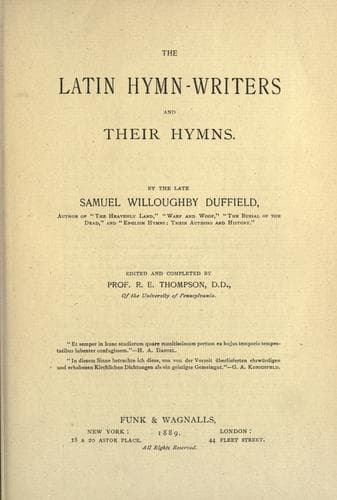
The Latin Hymn-writers and Their HymnsDuffield, Samuel Willoughby
Religion
The Latin Hymn-writers and Their Hymns
Duffield, Samuel Willoughby
Hymns, Latin -- History and criticism
The record of this endeavor to escape office reads singularly enough. He
first put some criminals to the torture, hoping by this means to shock
the people through his hard-hearted justice. When this would not do he
avowed philosophic rather than Christian sentiments. Having again
failed, he welcomed some very profligate persons—men and women—to his
palace in a way to invite scandal. This expedient being also detected he
actually escaped from the city by night, but lost his way and found
himself in front of the gates when morning dawned. This being his fourth
unavailing effort, he fled to a friend’s house in the country, begging
that he might lie hidden there until the first rush of feeling had been
stemmed and he could hope for calmer consideration of his refusal. But
the friend immediately betrayed him for his own good, and this
well-meant treachery fastened the mitre firmly on his brow. Basil the
Great gloried in this new coadjutor; and at the age of thirty-four or
thereabouts, he himself became convinced that he could struggle no
longer against his fate.
It was thus that Ambrose finally assumed the episcopate, and it was soon
evident that this catechumen—for he had not even been previously
baptized—respected its dignities and meant that others should be of the
same mind as himself. He gave up his private fortune, selling his large
estates and personal property, and reserving from them only a proper
allowance to his sister Marcellina, who had early taken the vow of
virginity. He associated with this proceeding the most strict method of
living. “He accepted no invitations to banquets; took dinner only on
Sunday, Saturday, and the festivals of celebrated martyrs; devoted the
greater part of the night to prayer, to the hitherto necessarily
neglected study of the Scriptures and the Greek fathers and to
theological writing; preached every Sunday and often in the week; was
accessible to all, most accessible to the poor and needy; and
administered his spiritual oversight, particularly his instruction of
catechumens, with the greatest fidelity.”
This is the character, admirably condensed, of a model bishop. To its
fulfilment it requires the fervent piety of a true Christian and the
constant zeal of an acute student together with the large prudence of a
man of affairs. All these are abundantly found in Ambrose. And if it
happened that in other and worse times his assertion of the spiritual
independence of a bishop gave a foundation for what became the authority
of the pope, it may be properly retorted that for him not to have done
so then would have prevented many another better thing in later ages.
Public-domain text, read in full here on John Shaqi.
Reviews
Reviews
No reviews yet
Be the first to share your thoughts on this work.
Elsewhere in the archive
Join the Discussion
Join the discussion
Sign in to leave a comment or review.
Sign InorCreate an account