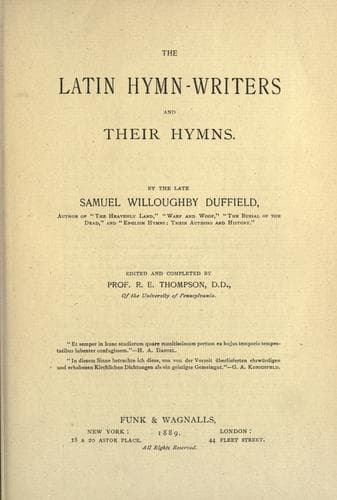
The Latin Hymn-writers and Their HymnsDuffield, Samuel Willoughby
Religion
The Latin Hymn-writers and Their Hymns
Duffield, Samuel Willoughby
Hymns, Latin -- History and criticism
He was a more polished scholar than Hilary, and a more devout Christian
than Damasus. Hence it was that his energy and skill contributed largely
to the success of the Nicene orthodoxy in the West. Those times were
troublous, and a cheerful and sunshiny temper like that of Ambrose was a
vast auxiliary to the cause. He had been consecrated in 374, eight days
after his election; and in 382 he presided at the synod in Aquileia
which deposed Palladius and Secundianus, the Arian bishops. By so doing,
and by his general attitude, he incurred the anger of Justina, whose
son, the younger Valentinian, he always upheld and shielded. The
Empress, however, determined to deal with him a good deal as Ahab’s wife
dealt with Elijah. This comparison takes additional point from the use
which Ambrose himself made of the story of Naboth in his defence of the
Portian Church.
He had already encountered the smouldering idolatry of old Rome, headed
by the rhetorician, Symmachus; but the eloquence of Ambrose had borne
down all opposition and that conflict was now at an end. A vindictive
woman was, however, a greater danger than a clever orator, and he found
this true when Justina, the Empress-mother, allied herself with the
heretical Arians. His pious zeal was kindled in a moment. Give up
churches to such a schismatic set as these? _Never!_
It was at Easter in the year 386 that the Portian Church and its holy
vessels were demanded for the use of the other party. Then stood up both
the old Roman and the new Christian in the single person of the Bishop
of Milan. He compared the demand to that of Ahab for Naboth’s vineyard;
and it may well be supposed that with the rush of such a torrent of
speech a current of inference was also borne along which involved
Justina herself. The sermon, which has survived to us, was preached on
Palm Sunday, and in it he said that he would hold every religious
edifice against heresy to the very death. Let them take his property;
let them depose or destroy himself; let them do their worst—but for his
part he would stand there unshaken for the truth. He would not incite
riot and confusion, but he would not yield. It was the anticipation of
Luther’s “_Hier stehe ich, ich kann nicht anders! Gott helfe mir!_” For
Ambrose proclaimed, almost in these actual words, “Here I stand, I
cannot do otherwise. God help me!”
He made one magnificent point in this discourse—the focal centre it was
of the entire outburst of eloquent declamation. It was when he quoted
what our Lord Himself had said. “Yes,” cries Ambrose, “give to Caesar
what is Caesar’s, but give to God what is God’s. Is the Church the
property of Caesar? Never! It belongs unalterably to God. For God, then,
it shall be kept. It shall never be surrendered to Caesar.”
Public-domain text, read in full here on John Shaqi.
Reviews
Reviews
No reviews yet
Be the first to share your thoughts on this work.
Elsewhere in the archive
Join the Discussion
Join the discussion
Sign in to leave a comment or review.
Sign InorCreate an account