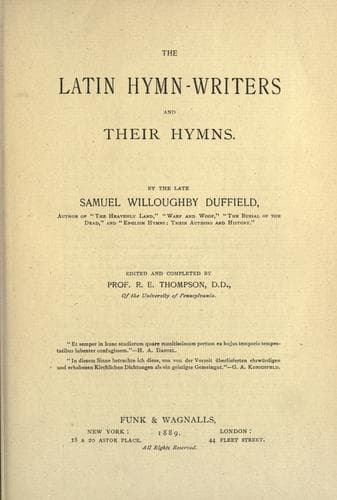
The Latin Hymn-writers and Their HymnsDuffield, Samuel Willoughby
Religion
The Latin Hymn-writers and Their Hymns
Duffield, Samuel Willoughby
Hymns, Latin -- History and criticism
The fight was really a siege. The sacred character of the churches
protected their defenders. Ambrose invigorated the multitude who flocked
to help him, and who organized relief parties to keep possession by day
and by night. To relieve the monotony of their watches, he frequently
addressed them words of encouragement. His fine equanimity triumphed
over the impending disaster. He taught the people there and then the
hymns of the early Church. He composed tunes and instructed them in
singing. And when at last he was able to discover the bodies of
Gervasius and Protasius, the ancient martyrs, he kindled in the spirits
of his hearers such a fire that the popular voice was heeded even by the
throne itself, and Justina was defeated and gave up the struggle. The
court actually retreated before the authority of the Church. And from
that moment, and that other memorable moment when he arraigned
Theodosius, Ambrose delivered the power of the bishop’s crozier from any
interference coming from the Emperor’s sceptre. Those were the days when
the pastoral staff might be of wood, but the man who wielded it was of
pure gold.
This account needs the story of Theodosius to be immediately attached to
it in order to make it stand out in its true relation to the character
of Ambrose. The bishop met three great enemies during his career. First
appeared Idolatry, championed by Symmachus; then followed Heresy,
championed by Justina; and now came Despotism, behind which stood the
beloved Theodosius, the Emperor-pupil, with his hands red from the
massacre of Thessalonica. The facts were these: a tumult had arisen in
the circus at that place; Botheric, an imperial officer, had been
killed; and the Emperor had in revenge put very many people to death.
Some have even run the figures up to the incredible altitude of thirty
thousand, and the massacre has been always regarded as involving seven
thousand victims at the lowest estimate. It was a brutal and a horrible
act, and Ambrose came out as Nathan did before David and denounced it
with the most withering reproaches. The Emperor cowered and bent before
this sirocco of the truth. The speaker was poised so high above him in
the assured calm of a steady rectitude that Theodosius could do nothing
except yield. And yield he did; and for eight months he paid penance
before he was restored. It was the penance of the German Henry which
hastened the Reformation; it was the humiliation of Theodosius which
preserved both rights and dignities to the Church.
Public-domain text, read in full here on John Shaqi.
Reviews
Reviews
No reviews yet
Be the first to share your thoughts on this work.
Elsewhere in the archive
Join the Discussion
Join the discussion
Sign in to leave a comment or review.
Sign InorCreate an account