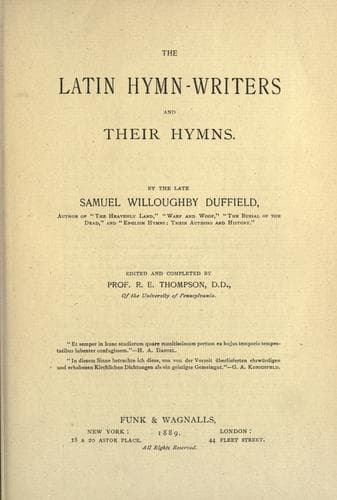
The Latin Hymn-writers and Their Hymns — John Shaqi
The Latin Hymn-writers and Their HymnsDuffield, Samuel Willoughby
Religion
The Latin Hymn-writers and Their Hymns
Duffield, Samuel Willoughby
Hymns, Latin -- History and criticism
Chicago, 1874, Auburn, 1876, Altoona, 1878, and Bloomfield, 1882, were
his subsequent pastorates; and in Bloomfield he remained until his
death. In this New Jersey suburb of New York City he seemed to find
himself especially at home. It was indeed the home of his early boyhood,
for his father had been pastor of the same church from 1847 to 1852; he
well remembered his playmates and schoolmates, and kept up his
acquaintance by correspondence and visits, until he came among them as
their pastor. He was near enough to the great city to find easy access
to its libraries, especially the Astor Library and that of Union
Seminary, and to enjoy the friendship of scholars of tastes similar to
his own, especially that of Dr. Charles S. Robinson. He found a
congenial people in his congregation. He took a lively interest in
matters relating to the welfare of the town, was an active member of the
Village Improvement Association, labored hard to establish a public
library, and helped to set on foot a good weekly paper. He became
Chaplain of the Fire Company, and preached a special sermon every year
to its members. He spoke always with enthusiasm of his new environment,
and seemed to look forward to many happy and useful years there. His
home life, I shall only say, was especially happy and helpful to him.
Among his delights was to watch the dawning powers of a daughter, who
inherits all her father’s poetic gifts.
His best poetical work is still unpublished, except such parts of it as
have appeared in the _Sunday-School Times_ and other weeklies. His first
venture was _The Heavenly Land, from the Rhythm of Bernard of Morlaix_
(New York, 1867). His second and most characteristic book was _Warp and
Woof: A Book of Verse_ (1868), in which “Undergraduate Orioles” and some
other pieces at once attracted attention by their felicitous beauty and
genuineness. Along with his father, he prepared _The Burial of the Dead_
(1882), a manual for use at funerals. In the long interval between these
two dates he was already laboring at his book on the Latin hymn-writers.
“During the years 1882-85,” writes Miss Day, “those of us who saw him
most frequently on his way to and from the New York libraries came to
recognize a large, square note-book and a green cloth bag as his
inseparable Monday companions. Something of their contents we knew, for
with his genial disposition he could not refrain from quoting snatches
of the old Latin hymns with translations into musical English. But no
one could appreciate the real worth of the knowledge concealed between
cloth and board as did the student himself, who had spent the hours of
leisure snatched from professional labors in the libraries, and among
Latin quartos and folios, in search of the materials for his book.
During the latter part of 1885 the Latin hymn-writers were laid aside
for a while to give time for his work on _English Hymns: Their Authors
and History_ (New York: Funk & Wagnalls, 1886),” which was suggested by
Public-domain text, read in full here on John Shaqi.
Reviews
Reviews
No reviews yet
Be the first to share your thoughts on this work.
Join the Discussion
Join the discussion
Sign in to leave a comment or review.
Sign InorCreate an account