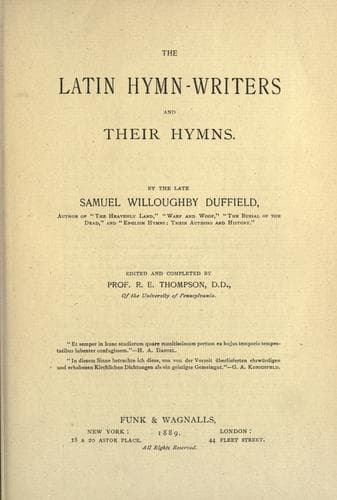
The Latin Hymn-writers and Their HymnsDuffield, Samuel Willoughby
Religion
The Latin Hymn-writers and Their Hymns
Duffield, Samuel Willoughby
Hymns, Latin -- History and criticism
If we ask Bentley his opinion of Prudentius he tells us that he is “the
Horace and Virgil of the Christians.” Milman declares that he was “the
great popular author of the Middle Ages,” and that “no work but the
Bible appears with so many glosses [commentaries] in High German.” “T.
D.,” away back in 1821, when dear old Kit North was editing _Blackwood_,
furnished that periodical with some poetical translations and remarked
that Prudentius was “the Latin Dr. Watts.” In La Rousse he obtains the
credit of being “the first Christian poet.” Among the earlier
contemporaneous, or slightly subsequent references his name is preceded
by the magic letters, “V. C.,” standing not, as some have thought, for
_Vir Consularis_, a man who had enjoyed the consulship, but for _Vir
Clarissimus_, a person of high distinction. It is reserved for the
“worthy and impartial” Du Pin to formulate a judgment more in accord
with the true facts of the case. “Prudentius,” saith Du Pin, “is no very
good poet, he often useth expressions not reconcilable to the purity of
Augustus’s Age.”
The value of his poetry turns largely upon its theological and
historical merits—both of which are considerable. It is not structurally
perfect by any means, and yet it has furnished several very lovely hymns
to the Church—graceful and delicate, rather than strong or inspiring.
In giving him his name it is safe to take that which is usually adopted:
_Aurelius Prudentius_, surnamed _Clemens_ or the Merciful. To this has
occasionally been prefixed _Quintus_ or _Marcus_, but neither has
sufficient authority in its favor. He was a Spaniard, and the main facts
concerning his life are learned from his own metrical preface to his
poems. Probably few questions have been more closely discussed by the
learned than this of his birthplace. The internal evidence is heaped up
on either side until it is seen that Calahorra [Calagurris] is probably
where he was born, while Saragossa [Caesarea-Augusta] was “his city” and
the place with which he was most identified.
Public-domain text, read in full here on John Shaqi.
Reviews
Reviews
No reviews yet
Be the first to share your thoughts on this work.
Elsewhere in the archive
Join the Discussion
Join the discussion
Sign in to leave a comment or review.
Sign InorCreate an account