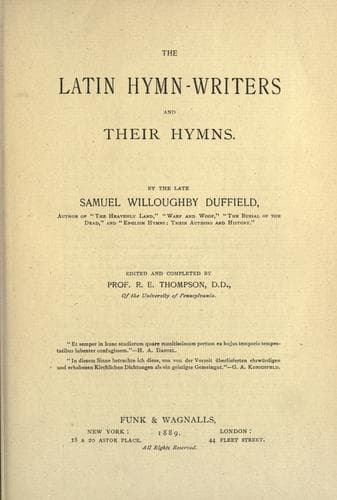
The Latin Hymn-writers and Their HymnsDuffield, Samuel Willoughby
Religion
The Latin Hymn-writers and Their Hymns
Duffield, Samuel Willoughby
Hymns, Latin -- History and criticism
He was doubtless of good family. Those industrious and microscopic
editors who have devoted themselves to his fame have laid great stress
upon the names _Aurelius_ and _Clemens_. The _Aurelii_, they say, were
distinguished and well-born people. The _Clementes_ were also of notable
memory. And there were two _Prudentii_ beside himself who obtained
rather more than ordinary distinction. Indeed, there were some five
_Prudentii_, early and late, and one of them, _Prudentius Amoenus_,
tried, indifferently badly, to climb to fame by an abridgment of his
predecessor’s history of the Old and New Testaments. In this he was so
successful that the original is now lost, the condensation alone
remains, and our Prudentius is often known as _Prudentius Major_, to
differentiate him from this troublesome _Minor_, who was a preceptor of
Walafrid Strabo. In regard to two other hymns—the _Corde natus_ and the
_Vidit anguis_—an element of doubt has been introduced by this same
person. Faustinus Arevalus was nothing if not a hymn-tinker (see
_Christian Remembrancer_, vol. xlvi., p. 125 _ff._), and it is possible
that these by such careless editorship have been incorporated into the
text of the true Prudentius from the pages of his namesake and imitator.
The hymn _Virgo Dei genitrix_ (of the fifteenth century) is ascribed to
another of the five Prudentii.
This sort of blunder is by no means unusual. We have an instance in
point with reference to the very Consul Salia in whose consulship our
poet tells us that he was born. A similarity between _Coss. Salia_ and
_Massalia_ misled the learned. They saw in this a proof that Massilia
(Marseilles) was his birthplace, and Prudentius was at once claimed for
France. But we have now unravelled and disentangled the greater part of
this obscure coil. Flavius Philippus and Flavius _Salia_ are known to
have served conjointly in the year 348, and hence the industry of Aldus
Manutius and Labbeus (Labbèe) has been thrown away and their false
conjecture has been abandoned.
Prudentius himself tells us nothing about his family, beyond what we
derive by inference. The deeper that we plunge into this labyrinth of
guesses the further we are from being settled in opinion. The
exhaustive—and, let us add, the exhausting—editor of the latest edition
finally calls a halt in the middle of his complicated Latin sentences
and avows himself utterly at a loss about the truth. There is then some
comfort left to us in cutting and untying these knots; for whatever view
we may advance has found distinguished and earnest championship already!
On the whole, Teoli appears a reliable leader, and him we have mostly
followed, as later authors, such as Professors Fiske and Teuffel, seem
to have done before us.
Public-domain text, read in full here on John Shaqi.
Reviews
Reviews
No reviews yet
Be the first to share your thoughts on this work.
Elsewhere in the archive
Join the Discussion
Join the discussion
Sign in to leave a comment or review.
Sign InorCreate an account