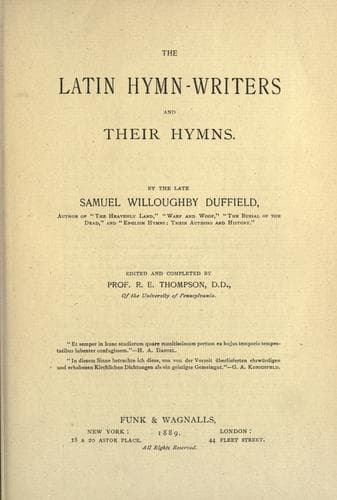
The Latin Hymn-writers and Their HymnsDuffield, Samuel Willoughby
Religion
The Latin Hymn-writers and Their Hymns
Duffield, Samuel Willoughby
Hymns, Latin -- History and criticism
One line in our author’s hymn in honor of St. Lawrence preserves an
historical fact which was not appreciated in its full significance until
our own times. He says, _Aedemque Laurenti tuam Vestalis intrat
Claudia_—“Claudia, the Vestal Virgin, enters Thy House.” In 1883 there
was discovered in the _Atrium_ of the Vestals a pedestal of a statue
dedicated to one of the heads of the order, from which her name had been
effaced purposely. Nothing of it was left except the initial C., while
there still remained the praise of “her chastity and her profound
knowledge in religious matters” (_Ob meritvm Castitatis Pvdicitiae adq.
in Sacris Religionibusqve Doctrinae Mirabilis_). The statue was erected
in the year 364, and the order was abolished by the younger Theodosius
in 394, so that her conversion must have taken place between those two
dates. The conversion of a person filling a place of such high honor in
pagan eyes, of a _Vestalis maxima_, must have been a severe blow to the
pagan party, which in Rome was making a fierce but hopeless fight for
the old worship. Yet we find no other reference to it in literature,
unless the letter of Symmachus to a Vestal, of whom he had heard that
she meant to withdraw from her order, was addressed to Claudia. See
Professor Lanciani’s _Ancient Rome in the Light of Recent Discoveries_,
pp. 170-72 (Boston, 1888).
It is uncertain in what year or in what part of Spain Prudentius died.
Conjecture varies between 410 and 424 A.D. This infinitude of filmy
particulars causes one to feel as if he were walking through spider-webs
of a morning in the country. This hard, practical nineteenth century
only experiences a sense of annoyance as it encounters the elaborate
nothings of that strangely laborious, all-gathering scholarship which
prevailed in the sixteenth and seventeenth. To create any intensity of
interest to-day requires an imagination which would sacrifice truth to
attractiveness.
But certainly, from what we can see of the man in his works, we can have
no hesitation in pronouncing a verdict highly favorable both to his
poetry and his piety. As governor of important towns he merited—or he
would scarcely have received—his title of “the Merciful.” As a close
observer of his time and a student of its thought, he has preserved for
us what we cannot spare. It is he who in the _Jam moesta quiesce
querela_ struck the first notes which were to vibrate in the _Dies
irae_. It is he again who in the _Ales die nuntius_ anticipated Henry
Vaughan and his
“Father of lights, what sunny seed,
What glance of day hast thou confined
Into this bird!”
The hymn is as follows:
“The bird, the messenger of day,
Cries the approaching light;
And thus doth Christ, who calleth us
Our minds to life excite.
“Bear off, he cries, these beds of ease
Where lie the sick and dumb;
And let the chaste and pure and true
Watch, for I quickly come.
Public-domain text, read in full here on John Shaqi.
Reviews
Reviews
No reviews yet
Be the first to share your thoughts on this work.
Elsewhere in the archive
Join the Discussion
Join the discussion
Sign in to leave a comment or review.
Sign InorCreate an account