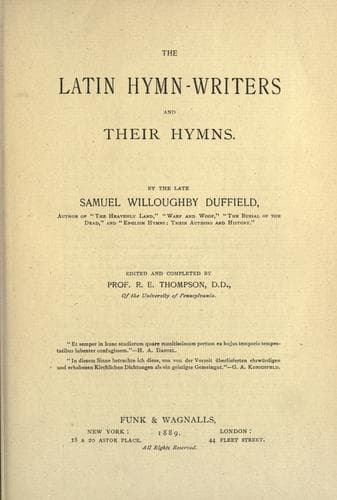
The Latin Hymn-writers and Their HymnsDuffield, Samuel Willoughby
Religion
The Latin Hymn-writers and Their Hymns
Duffield, Samuel Willoughby
Hymns, Latin -- History and criticism
The _Peristephanon_ (Concerning Crowns) has twelve hymns in honor of
various martyrs. Mr. Simcox notes that these are almost idyllic in form,
and that there is much made of the white dove which flies from the
burning pile about St. Eulalia and of the violets which the girls should
bring to the tombs of the virgin martyrs. It may be interesting to name
the martyrs thus celebrated. There were two from Calahorra; then
Laurentius and Eulalia; eighteen who suffered at Saragossa; Vincentius,
and finally Fructuosus and Quirinus, bishops both.
Then comes a poem on the Baptistery at Calahorra (translated in
_Blackwood_, vol. ix., p. 192), with a description of the deaths of
Cassian, Romanus, Hippolytus, Peter and Paul the apostles, Cyprian and
Agnes. These poems, it should be said, are various in metre and some are
quite long.
The _Cathemerinon_ (a Book of Hours) is the real mine whence the most of
the hymns which were composed by Prudentius are taken. In this we have
hymns for cock-crowing and morning; before and after food; at the
lighting of the lamp; and before retiring to rest. With these are joined
others for the use of those who are fasting, and at the conclusion of
the fast; for all hours and at the burial of the dead; the work ending
with hymns for Christmas and Epiphany.
The _Apotheosis_ consists of poems relating to the errors of all the
heretics that can be named—Patripassians, Arians, Sabellians,
Manichaeans, Docetae, etc. The value of this to ecclesiastical history
is easily perceived. It has more than a thousand hexameters and it
treats additionally of the nature of the soul and of sin and of the
resurrection.
The _Hamartigenia_ (the Origin of Evil) takes up original sin as against
Marcion; and the _Dittochaeon_ (which possibly means Double Food) is the
abridgment of Old and New Testaments. This last is a sort of religious
picture gallery ranging from Adam to the Apocalypse in hexametrical
epigrams. There is reason to doubt whether it be what Prudentius
originally composed. If he followed his usual vein of abundant verse,
there is no question but that these half a hundred epigrams would be
more popular than his very extensive poetical treatment of such
subjects.
It is left us to mention the two books against Symmachus, the Roman
senator, whom Ambrose so earnestly and successfully opposed. Symmachus
had purposed to restore the idols, revive the revenues of the pagan
temples, and generally to cast out Christianity from Rome. The poetry of
Prudentius is again valuable here, for it plunges into the origin and
baseness of idolatry, describing the conversion of Rome, and presenting
a picture of the times which is invaluable to the historian. It is from
the pages of Prudentius that we learn the cruelty of the purest of the
Roman women, when
“The modest vestal, with her down-turned thumb
Urges the gladiator to his stroke
Lest life may lurk in any vital place!”
Public-domain text, read in full here on John Shaqi.
Reviews
Reviews
No reviews yet
Be the first to share your thoughts on this work.
Elsewhere in the archive
Join the Discussion
Join the discussion
Sign in to leave a comment or review.
Sign InorCreate an account