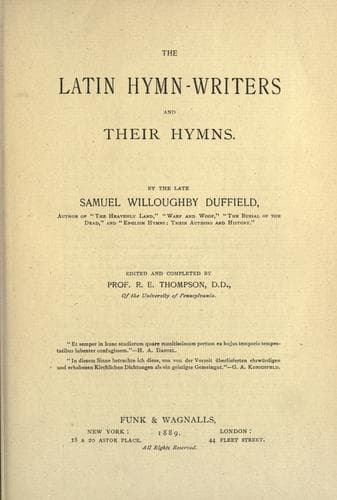
The Latin Hymn-writers and Their HymnsDuffield, Samuel Willoughby
Religion
The Latin Hymn-writers and Their Hymns
Duffield, Samuel Willoughby
Hymns, Latin -- History and criticism
Rambach says, in his Anthology, that none of the hymns of Ennodius have
been adopted by the Church. “Nor have I,” adds Daniel, “found in any
breviary a verse of Ennodius. Yet,” he continues, “since there are many
of them in the collection of Thomasius, which have been taken from the
Mozarabic Breviary, it seems to me certain that in some countries they
were formerly employed by the Church.” Some corruption has also taken
place in the text. And, in short, these hymns have never appeared either
devout or original enough to secure the suffrages of the faithful.
The reason for their emptiness is not far to seek. Their author was a
man of great celebrity but of little piety. His reputation, too, is that
of an ardent ecclesiast, who managed to climb the heights of saintship
by working in the interest of the Roman pontiff. He labored to maintain
the supremacy of the Pope—upon whom, it is said, on good authority, that
he was the first to bestow the world-wide appellation of Papa (Pope)—and
to effect the union under this one religious head of both Greek and
Roman churches. To this single cause, with its double aspect, Ennodius
gave his talents and his zeal. He was so far successful that he gained
honor and position for himself, however he was prospered in his other
plans.
He was a person of sufficient prominence for Italy and Gaul to contest
the honor of his birth. It would appear, however, that Gaul has the best
title to whatever credit his nationality may give. The works on
hymnology do not mention him, and the only notices of his life and
writings are to be found in out-of-the-way corners of books on Latin
literature and in the controversial pages of Church historians. Those
who attack and those who defend the papal claims, are in the habit of
mentioning the two embassies of Ennodius as notable points in their
argument; but the man is lost from sight in the paramount importance of
his mission. It cannot be so with us, to whom his personal character is
the topic of interest, and who care only for his circumstances as these
develop him to us upon his hymnologic side.
Public-domain text, read in full here on John Shaqi.
Reviews
Reviews
No reviews yet
Be the first to share your thoughts on this work.
Elsewhere in the archive
Join the Discussion
Join the discussion
Sign in to leave a comment or review.
Sign InorCreate an account