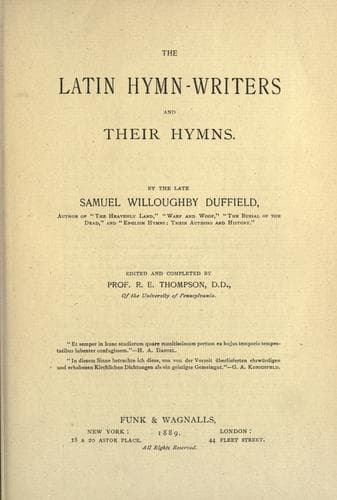
The Latin Hymn-writers and Their HymnsDuffield, Samuel Willoughby
Religion
The Latin Hymn-writers and Their Hymns
Duffield, Samuel Willoughby
Hymns, Latin -- History and criticism
Ennodius has himself informed us that he regarded Arles as his native
place. We also know that he was born in 473, because he died in 521 at
the age of forty-eight. His family was highly respectable, if, indeed,
it was not actually illustrious. Our poet always shows a familiarity
with the affairs of good society; and in those times good society had
only one meaning. It was a society which educated its scions in the
polite learning of Greece and Rome, and which made much of the ability
to speak and write the Latin tongue. It is scarcely to be questioned
that this was the theory on which the early education of Ennodius
proceeded. He was sent to Milan in order to become versed in what was
called humane learning. If he is himself to be believed he acquired both
bad and good in this school. He laments with a mock humility (for so it
would appear by his later literary derelictions) that he had obtained a
great deal of wicked and ungodly information; and really no one can read
some of his nasty epigrams and doubt his assertion. For, whether it was
permissible to a saint or not, it is a fact, that the editors of his
works have not scrupled to print some exceedingly profane and improper
pieces which are undoubtedly the product of his pen.
His aunt, who was bearing the cost of this admirable instruction, died
in 489—that is, when he was sixteen—and he was left without means to
proceed with his studies. He avows that he had come to detest the very
name of liberal education, and this, under the circumstances, cannot
well be regarded as anything very surprising. We soon after find him
married to a lady who is described as of a “most noble” and therefore
highly appropriate family. She was, moreover, “very rich”—another
satisfactory point. With this wealthy and fashionable wife, Ennodius
rapidly obtained a view of earth, and what earth can give, which was so
far limited in that the money did not equal the desires of the married
pair. It ran low and the bitterness of financial perplexities mingled
with the cup of their happiness. Judging the husband by his epigrams he
was pretty fairly exhausted by the speed of their career, and was quite
ready to shake off the encumbrance of a family and devote himself to the
lofty purpose of being supported by somebody else. An unprejudiced mind
fails to see in this any particular “admonition” or “example” to his
age. It is merely the selfish escape of a worldly but embarrassed man.
Divorces were not available then with the ease with which a less
scrupulous and more intellectual generation can now procure them. The
proper, and, indeed, the meritorious way, was to slip into a cloister
and become one of that vast army which was soon to be the tower of
strength of the Pope. He himself ascribes this step to a serious illness
in which he had been healed through the miraculous interposition of St.
Victor, after the doctors had given up his case.
Public-domain text, read in full here on John Shaqi.
Reviews
Reviews
No reviews yet
Be the first to share your thoughts on this work.
Elsewhere in the archive
Join the Discussion
Join the discussion
Sign in to leave a comment or review.
Sign InorCreate an account