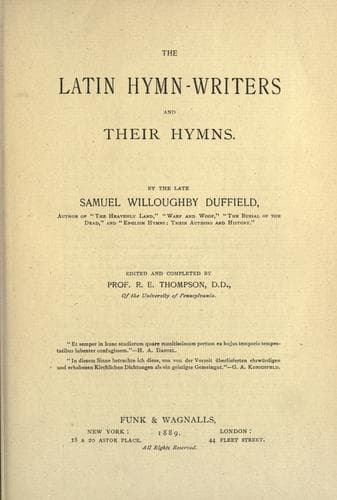
The Latin Hymn-writers and Their HymnsDuffield, Samuel Willoughby
Religion
The Latin Hymn-writers and Their Hymns
Duffield, Samuel Willoughby
Hymns, Latin -- History and criticism
The literary capacity of Ennodius next attracts attention. His patron
(who must not be confused with the great Bishop of Salamis, the author
of the famous _Heresies_, who belongs to the previous century) died
before 510. Maximus III. had succeeded Epiphanius, and after his death
our Ennodius, in 510 or 511, was selected for the vacant diocese. The
name of this episcopate was Ticinum, or, as we now style it, Pavia. It
is plain that the bestowal of this dignity was hastened by the fact that
our scholar while still a deacon had defended Pope Symmachus before the
Roman synod called “Palmare,” and so effectually that the discourse was
entered on the acts of the council, where it still appears. The Pope had
been charged with crimes, and a synod convoked by the heretical
Theodoric was to decide the case. The date was October, 501. The place
was a portico of the church of St. Peter at Rome to which this name of
Palmare was usually given. And the speech is historic inasmuch as it is
the earliest recorded instance of that assertion of supremacy on the
part of the Roman pontiff which frees him from any responsibility to
earthly rulers. Ennodius thus became the advocate of this dogma, and
upon the broad wings of papal favor he soared to the high station which
his patron Epiphanius had quitted.
This burst of declamatory eloquence did not come without preparatory
training. Ennodius had been exercised in the art of declamation in his
youthful days and, as a deacon, he was able to utilize his knowledge. In
510 or 511, not long after his elevation to the mitre, he wrote the life
of his friend and predecessor. And this he followed with divers
performances of a literary character which were generously applauded. He
became a sort of hero in the world of letters, and whatever he was
pleased to compose was heartily commended.
In 515 it was natural that such an advocate of the absolute domination
of the Roman pontiff should be selected to help in the effort to reunite
the Eastern Church to the Western. The ambassadors were himself, the
Bishop of Pavia; Fortunatus, Bishop of Catania; Venantius, a presbyter;
Vitalis, a deacon, and Hilarius, a notary and scribe. These names
themselves reveal a not infrequent source of confusion to students of
that distressingly barren period, when it was regarded as a very
pleasant compliment to call the son of a nobody by the distinguished
appellation of some great person in the Church. In this manner Hilary
and Fortunatus suffered then, and modern scholars have been often vexed
and perplexed since, especially when dates come near together. It hardly
needs to be added that these wearers of illustrious names have only that
meed of renown, such as it is.
Public-domain text, read in full here on John Shaqi.
Reviews
Reviews
No reviews yet
Be the first to share your thoughts on this work.
Elsewhere in the archive
Join the Discussion
Join the discussion
Sign in to leave a comment or review.
Sign InorCreate an account